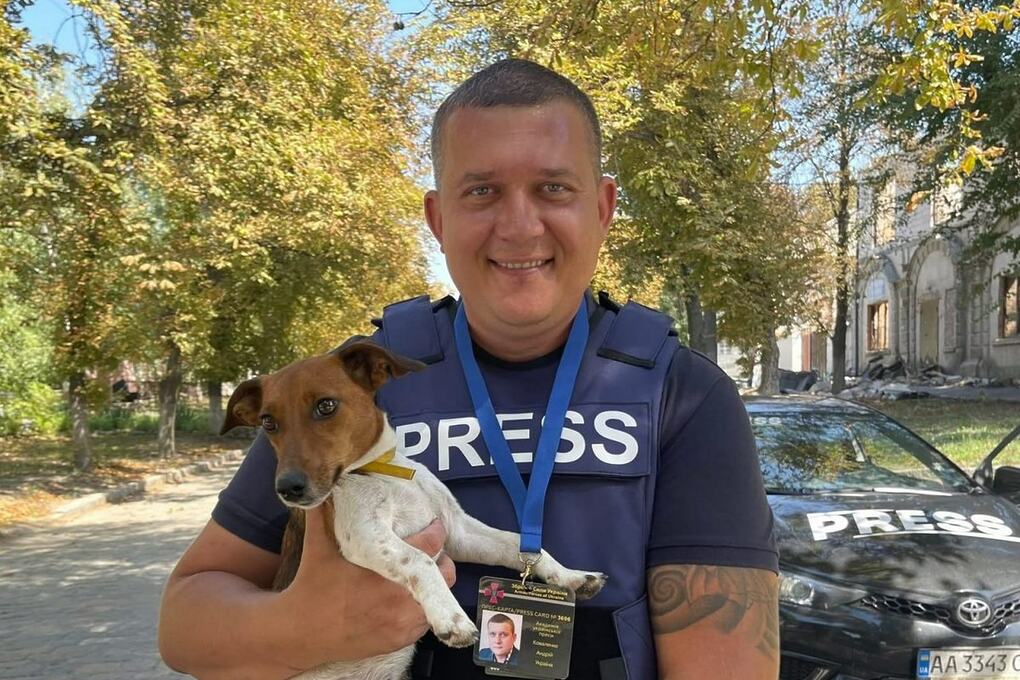
Journalists must keep pace with the front, says war correspondent Andrii Kovalenko
War correspondent, international media producer and Academy of Ukrainian Press Executive Director Andrii Kovalenko discussed changing safety practices near the front at an expert discussion at NUJU’s office. He explained why journalists need military support and why a drone detector alone is no longer enough.
‘Journalists must change how they work as military technologies change’
‘Will a Chuika detector bring down a drone? Of course not. But it is an excellent decision-making tool because it gives you those golden minutes that can save your life,’ Kovalenko explained.
He and his team use drone detectors constantly while working in so-called kill zones, areas exposed to pervasive attacks. The problem is that these zones are expanding very quickly, making it essential to respond to the changes.
‘As military technologies change, we journalists also have to change how we work,’ he stressed.
‘The military even see the sky differently’
He identifies a fundamental change: a journalist can no longer reach locations closer to the front in their own vehicle with only their own team.
‘It is effectively impossible without electronic warfare equipment. Journalists are prohibited from using it. Secondly, it is very expensive.’
Kovalenko therefore believes that journalists can now work near the front only alongside the military. A press officer has more information about current aerial threats and a better understanding of the equipment. He also said journalists were not permitted to carry means of intercepting drones, whether nets, handguns or pump-action shotguns, although colleagues were beginning to raise the issue.
‘Thank goodness if the military accompanying you have them, because very often that saves lives.’
Military personnel, he said, observe differently: watching the sky, dividing it into sectors and involving a separate team, as a vehicle usually holds no more than four or five people.
‘The military simply remove PRESS stickers’
Markings were another subject. Kovalenko was categorical that PRESS stickers on vehicles no longer offered protection.
‘Because the Russians do not care about any of the conventions.’
He said that, from around 2023, military personnel had begun removing such stickers before journalists set off.
Journalists should not look like soldiers, he argued, and could use blue or black body armour. Vehicles can introduce additional risks:
‘I even had to change my car because it looked like a military vehicle. It genuinely became frightening to drive.’
He said a vehicle now needed four-wheel drive and an unobtrusive appearance, without unnecessary features of a heavily equipped off-roader.
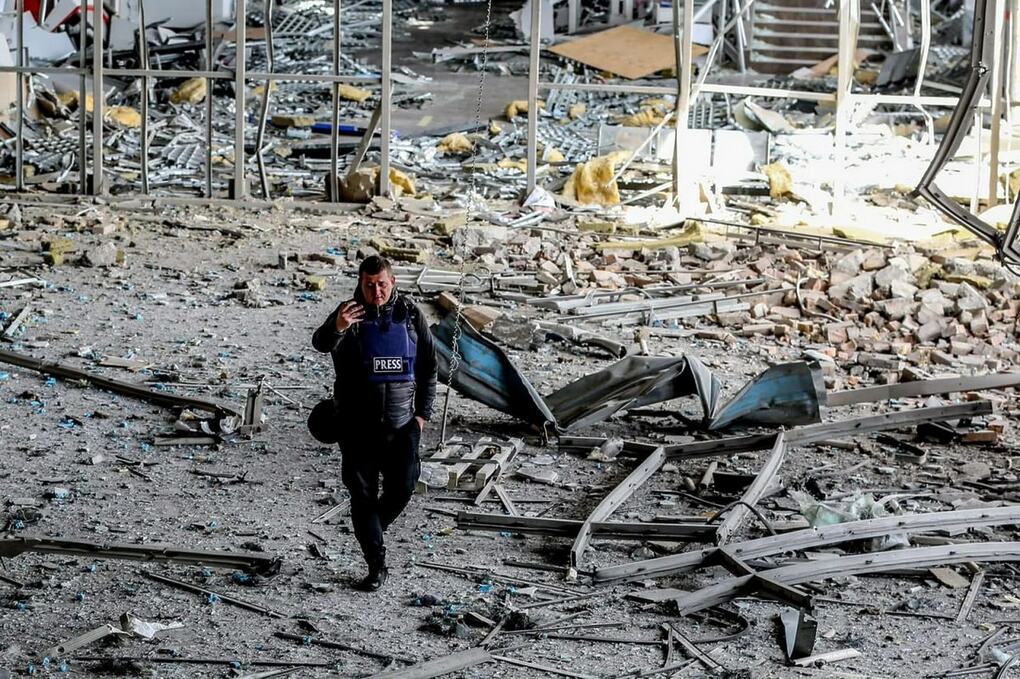
‘I support wearing body armour’
The discussion also addressed protective equipment. Moderator and NUJU President Sergiy Tomilenko noted that journalists in frontline regions often rejected heavy body armour as cumbersome and worked without protection. One proposal under discussion was to provide lighter, close-fitting security-type vests: a two-kilogram vest would be better than nothing.
Kovalenko confirmed that colleagues took different approaches. Some concealed armour beneath clothing to maintain a civilian appearance; others did not wear it because it could complicate relationships with interviewees in frontline towns.
‘If you are working in Kherson, Kramatorsk or Druzhkivka, where people live through all of this, and you arrive in body armour and start telling them things, it looks strange, to put it mildly.’
His own position was clear:
‘I support wearing body armour. It is your protection and it can save your life.’
‘A training programme becomes outdated before the course has even finished’
Kovalenko also considered journalism’s psychological dimension in extreme conditions. Understanding what one has experienced comes afterwards, he said. This needs discussion alongside burnout.
He emphasised continually updating safety skills:
‘A training programme becomes outdated before the course has even finished.’
In his view, tactical medicine skills need practice at least three or four times a year rather than once. A team should know where each member keeps their tourniquet, down to the pocket.
‘We now need to keep pace with what is happening at the front, so that we can work effectively and stay alive.’
The discussion and practical support
Kovalenko spoke at Journalism Under Drone Attacks: Safety, Support and Professional Solidarity, an expert discussion at NUJU’s office on 10 June.
Tomilenko presented a new practical handbook on journalists’ safety amid drone threats, prepared with support from the Swiss foundation Fondation Hirondelle. The Journalists’ Solidarity Centres network also received a new batch of Chuika drone detectors from Ukrainian manufacturer BlueBird Tech. These will be available for journalists to borrow free of charge through the centres in Kyiv, Sumy and Odesa Oblast. The centres’ role as safe support points for media workers was highlighted separately.
Participants discussed technical protection and the need to update safety protocols. One central change observed in practice was that PRESS markings no longer provide protection and may instead make journalists priority targets.
The discussion also heard war correspondent Olha Kalinovska’s account of new dangers arising from drone technology.
The discussion showed how Russia’s war continually creates new challenges for media. Alongside defending freedom of expression, priorities include journalists’ physical safety, support for local producers and fixers, and professional networks of mutual assistance. NUJU and the Journalists’ Solidarity Centres direct their initiatives towards these needs.
Translation note: This is a literary translation into British English, produced and proofread using a language model. Read the Ukrainian original.