Ukraine shows the world the environmental consequences of war
At the 31st UN Climate Change Conference (COP31), currently taking place in Antalya, Türkiye, Ukraine has reminded the world of the environmental cost of the large-scale war of aggression unleashed in Europe by the Russian regime.
Water is the central theme of Ukraine’s pavilion. It tells the story of the destruction of the Kakhovka Hydroelectric Power Plant, pollution in the Dnipro and Danube rivers, devastated natural areas, and the damaging effects of the prolonged war on the Black Sea and the Sea of Azov. Alongside repelling the armed attack, Ukraine needs to document the occupiers’ environmental crimes, assess the damage and establish international mechanisms to hold the aggressor state accountable.
At events and discussions in Antalya, participants from Ukraine are drawing attention to humanitarian demining, the restoration of forests and nature reserves, the protection of Crimea’s natural and cultural heritage, and the decentralisation of energy generation.
A threat to Europe’s security
According to the State Environmental Inspectorate of Ukraine, confirmed environmental damage alone has exceeded UAH 7 trillion since the start of Russia’s full-scale invasion. The war unleashed by Moscow is not only a humanitarian and security catastrophe in Europe. It also poses a major threat to the continent’s environmental security.
The international forum in Türkiye is addressing the transition to clean energy, reduced fossil fuel use, the expansion of electrification, and funding to help countries adapt to climate change. COP31’s main task is to turn climate agreements into practical decisions to combat global warming.
Droughts, forest fires, floods and melting glaciers pose a serious threat to humanity. These events are closely linked to the accumulation of carbon dioxide (CO₂) in the atmosphere. According to scientists whose findings were published in BioScience in autumn 2026, atmospheric CO₂ concentrations in May this year exceeded levels seen for at least two million years. Meanwhile, fossil fuel consumption continues to grow. Last year, the use of coal, oil and natural gas reached record levels, with associated energy-related carbon dioxide emissions exceeding 41 billion tonnes for the first time. To put that in perspective, transporting such a load in standard 20-tonne trucks would require 2.05 billion vehicles.
The planet is growing darker — and that is dangerous
Several years ago, the author of this article visited Japan and saw first-hand how emissions from waste incinerators and coal-fired power plants are cleaned. Any whitish “smoke” visible above the chimneys was simply water vapour. Japan has had an Air Pollution Control Act since 1968. It regulates not only coal-fired electricity generation but also industrial activities involving waste. Today, emissions from Japan’s power plants contain no carbon particles and do not contribute to global warming.
One advocate for reducing air pollution is Jun-ichi Kowaka, a civic activist and food safety expert well known in Ukraine who heads the Japan Offspring Fund. A resident of Saitama, he was a winner of Ukraine’s national “Charitable Ukraine – 2022” competition in the “Media and Charity” category. Before the full-scale war, he and his colleagues frequently visited Ukraine. Having studied environmental issues in Japan and Europe, he draws attention to the dangers of black carbon: soot produced by burning fossil fuels.
He explains that dust carried by the wind from Mongolia to Japan used to be yellow. Now, it is often dark. “As it passes over China, the dust mixes with soot and other fine particles. Black carbon absorbs sunlight and warms the atmosphere,” Mr Kowaka explains.
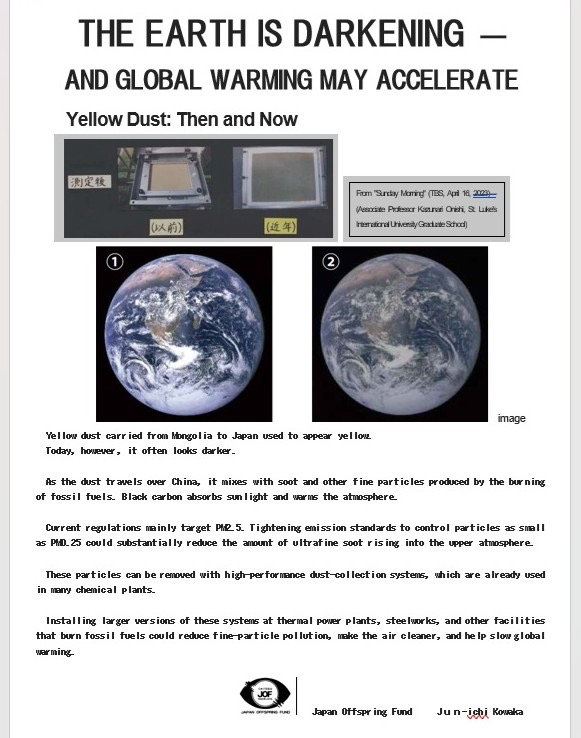
The Japanese activist proposes making environmental standards for controlling the smallest pollution particles released with smoke at least ten times stricter. In his view, it is not enough to rely mainly on the existing limits for particles measuring 2.5 micrometres (PM2.5). A PM0.25 filtration standard is needed for particles approximately 300 times thinner than a human hair.
Jun-ichi Kowaka believes that stricter flue-gas cleaning requirements should become an important part of international climate policy. Modern technologies can efficiently capture microscopic dust using wet electrostatic precipitators and other high-performance systems. Such solutions could help reduce soot emissions from thermal power plants, steelworks and other industrial facilities.
One moving example comes to mind of Mr Kowaka’s personal contribution to tackling global warming. On the eve of the full-scale war, he used his own money to fund the purchase of filters for boiler houses at educational institutions in Ukraine’s Zhytomyr region. The head of one secondary school told the donor that flue-gas cleaning units had been delivered to two rural schools and that USD 4,800 was needed to buy materials and install them, according to a letter dated 23 February 2022. The very next night, on 24 February, Russian forces launched missile attacks on Ukraine and invaded several regions in the north, east and south in columns of military vehicles.
At the conference in Antalya, Ukraine is describing the destruction caused by the war while sharing its experience of environmental recovery and energy resilience. It is also drawing the world’s attention to the urgent need to end Russian aggression. Safe water, clean air and a stable climate are a shared human inheritance.
Serhii Shevchenko
Member of the Board of the Kyiv Regional Organization of the National Union of Journalists of Ukraine (NUJU)