
Information Bubble: an exercise about algorithms and critical thinking
An information bubble is a personalised environment shaped by social media algorithms through what we watch, follow and respond to. For educators, media trainers and Ukrainian communities, recognising this algorithmic isolation forms part of media literacy and information resilience. An original exercise piloted in AUP’s trainers’ laboratory uses Zaporizhzhia examples to explore broadening sources, checking content and managing an information diet consciously.
Contents
- The trainers’ laboratory
- Svitlana Bohdziievych’s original exercise
- Where it was presented
- The exercise’s purpose
- Its value for trainers
- Participants’ recommendations
- Resilience and conscious choice
- About FreeMind Ukraine
The trainers’ laboratory
How do social media algorithms shape our view of the world, and why should we manage our information environment deliberately? ‘Information Bubble’, presented at AUP’s trainers’ laboratory, helps answer these questions.
‘Filter Information, Create Change: Trainers’ Laboratory. A Hackathon of Practices’ was conceived as a place for learning and exchanging professional experience across generations. AUP has developed media literacy in Ukraine for more than fifteen years and trained over 1,100 trainers.
The laboratory introduced new trainers to contemporary challenges and shared methods developed by longstanding AUP partners. Trainers presented their own exercises; participants analysed, discussed and adapted them for different audiences and debriefed together. This tested activities professionally and provided expert feedback.
The five two-day online courses involved 109 media literacy trainers. Read AUP’s report on the completed training series.
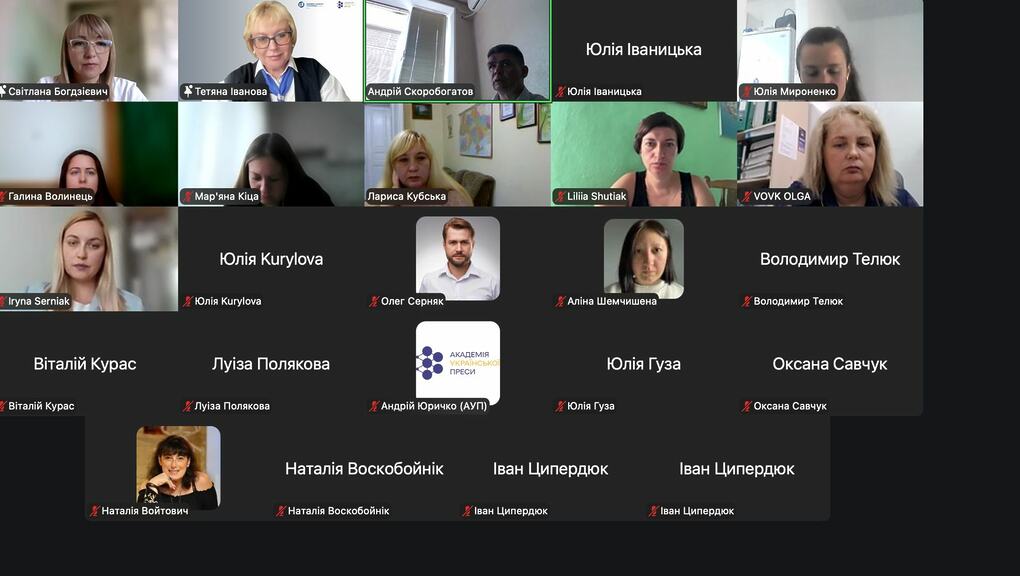
Participants in ‘Filter Information, Create Change: Trainers’ Laboratory. A Hackathon of Practices’.
Svitlana Bohdziievych’s original exercise
We are beginning a closer examination of laboratory exercises and their potential for different audiences. First is ‘Information Bubble’, developed by Svitlana Bohdziievych, a Ukrainian language, literature and media culture teacher at Zaporizhzhia Academic Lyceum No. 93, under Zaporizhzhia City Council.
She also advises the City Council’s Centre for Teachers’ Professional Development and is an AUP media literacy trainer. Since 2018, she has introduced media literacy to different population groups.
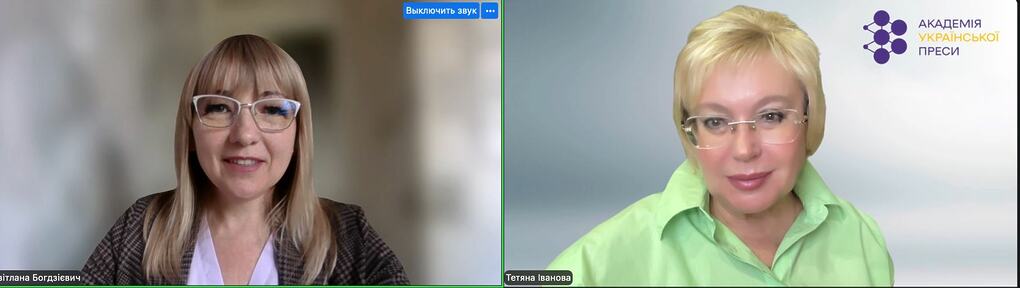
Svitlana Bohdziievych and Tetiana Ivanova during the trainers’ laboratory.
Where the exercise was presented
Svitlana presented the activity through the ‘Filter Information, Create Change’ laboratory. Five courses addressed groups with different needs. More than a hundred participants encountered the exercise and rated its potential highly.
The purpose of ‘Information Bubble’
The exercise helps participants recognise that information environments are neither neutral nor accidental. They emerge from preferences, reactions, sources, subscriptions and digital habits, together with platform algorithms selecting content around observed interests.
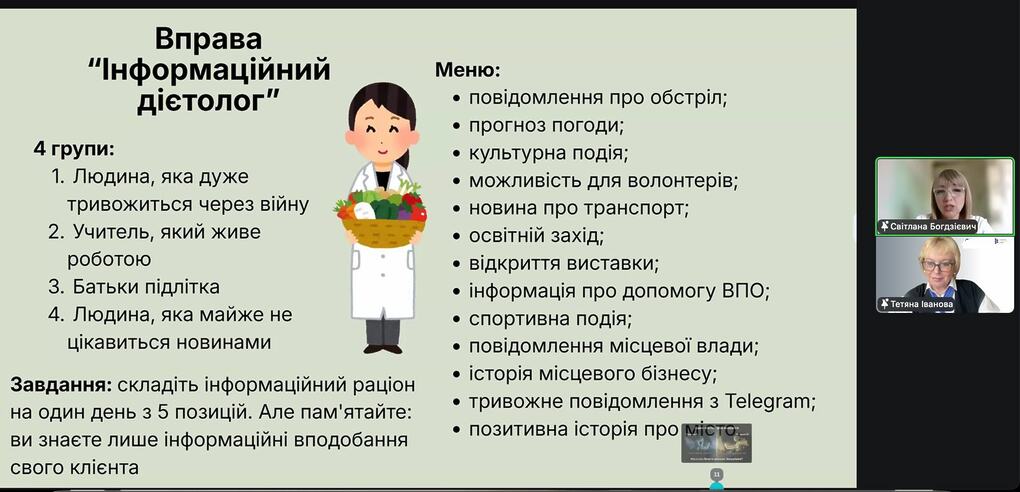
An excerpt from the original ‘Information Dietitian’ exercise.
This matters particularly during information warfare. The enemy studies our preferences, emotional responses and vulnerabilities, while algorithms can spread content that most strongly upsets, alarms or polarises us.
As Svitlana emphasised, recognising false information is not enough. We need to understand why information reaches us, how it shapes our worldview and how that creates opportunities for influence.
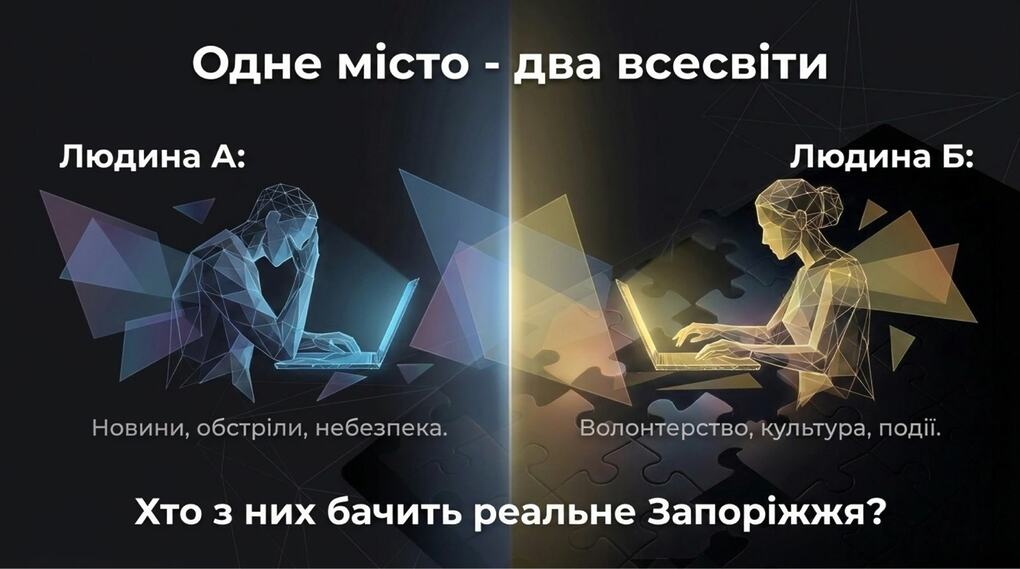
‘One City, Two Universes’: different information bubbles create different views of Zaporizhzhia.
Why it is useful for media literacy trainers
The exercise’s strength is its progression from personal experience to critical examination of how a bubble forms, rather than a definition alone.
Recognising a bubble
The first stage shows how an information environment forms around the topics, sources and messages someone engages with most often, rather than randomly.
Analysing algorithms
The next stage explores causes: why this particular bubble emerged, how our actions contributed and how platforms, recommendation systems and algorithms reinforce familiar narratives, topics and emotions.
Reflecting on consequences
Participants then consider prolonged exposure to a closed environment: effects on perceptions, attitudes towards other opinions, anxiety and readiness to examine information critically.
Finding practical responses
The closing stages identify actions: clearing one’s information environment, diversifying sources and developing healthier information habits.
Participants’ recommendations
In their joint review, trainers suggested strengthening the exercise in several ways.
1. Divide brainstorming into two parts
First, trace how a bubble forms: what enters it, why and which digital actions initiate the process.
Next, adopt the illustrative role of an ‘information dietitian’: discuss clearing the bubble, verifying content, expanding sources and choosing better-quality, more balanced news.
This moves the exercise from diagnosing a problem to practising media hygiene.
2. Add a separate debate
Participants proposed a debate to examine why and how algorithms offer the content forming a bubble.
This moves beyond everyday impressions of social media to wider mechanisms of digital influence: attention, behaviour, emotions and opportunities for manipulation, not the newsfeed alone.
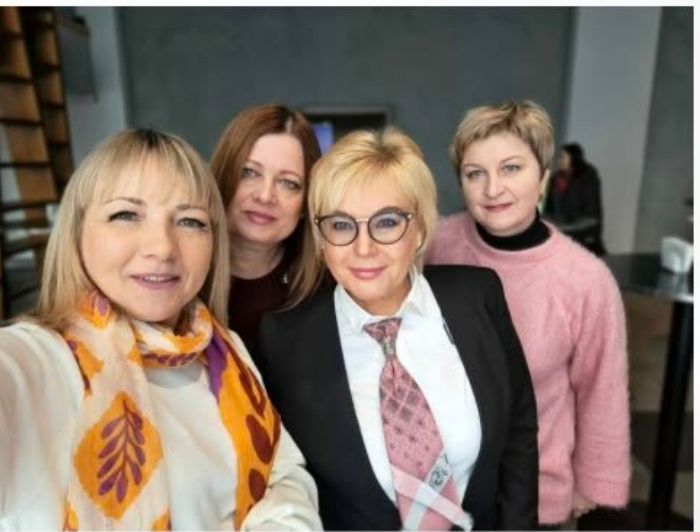
Participants in AUP’s media literacy trainers’ laboratory.
Information resilience begins with conscious choice
Participants concluded that Svitlana’s exercise is particularly relevant in contemporary Ukraine. It explains algorithmic influence, why people may not see the whole picture and how the enemy can exploit information preferences.
Trainers also identified a dimension they described as psychotherapeutic. Even amid war, strain and persistent negative news, people retain some room for choice. We cannot always control the external information flow, but we can understand its nature and take responsibility for our own environment.
Do we want to live in constant fear and negativity, or can we find strength to live, remain resilient and prevail? We demonstrate this every day.
‘Information Bubble’ is therefore an exercise about algorithms, freedom of choice, resilience and inner strength.
Tetiana Ivanova
Trainer, ‘Filter Information, Create Change: Trainers’ Laboratory. A Hackathon of Practices’, 2026.
About FreeMind Ukraine
AUP implements ‘FreeMind Ukraine: Youth and Communities Against Manipulation’ with the Centre for Media and Information Literacy (CeMIL) at Freie Universität Berlin’s Institute for Media and Communication Studies in Germany. It develops critical thinking and media literacy among young people and Ukrainian communities.
The programme includes online training for opinion leaders and community representatives, mentoring for media literacy initiatives, support for local multiplier events, youth training and the FreeMind Community online network.
AUP’s implementation partner is CeMIL at Freie Universität Berlin.
CeMIL offers contemporary media literacy expertise and extensive training and research experience with Eastern European journalists and communication scholars. It has also implemented projects in previous Eastern Partnership programme rounds.
Translation note: This is a literary translation into British English, produced and proofread using a language model. Read the Ukrainian original.