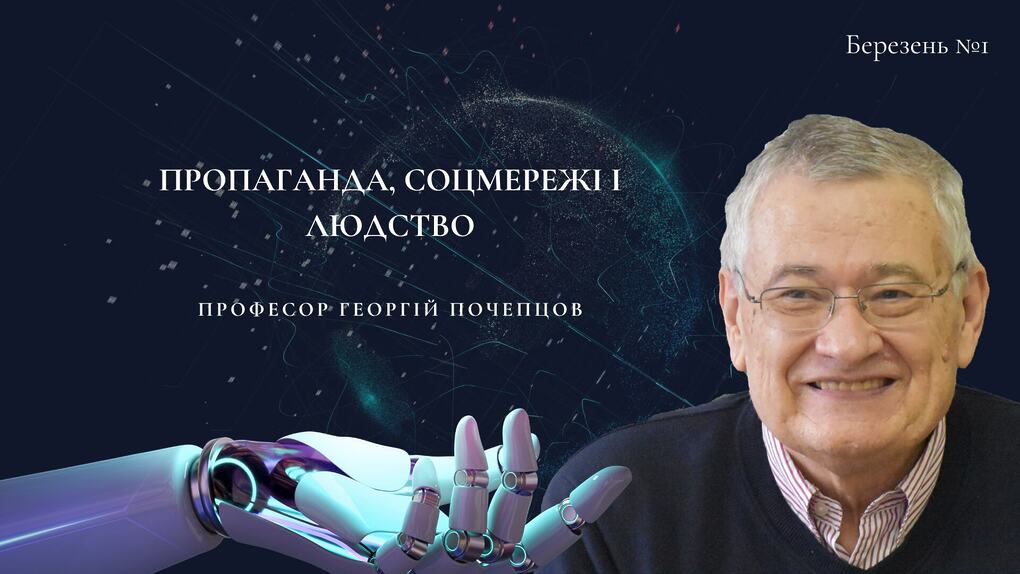
Propaganda, social media and humanity
Political propaganda is always and everywhere a lever of power. That is why it becomes so powerful that it cannot be avoided. The authorities, above all, have the means to make it so. Business can reach people differently: through attraction rather than punishment, which is precisely what it does…
Information wars have always existed; today their tools have simply become more precise and cheaper. This concerns new technologies that can reach everyone, but also everyone’s need to know what propagandists think about a particular issue. Behind them stands the voice of authority, with its power to reward and punish each of us.
Propaganda is a kind of information compass, enabling us to maintain our direction through the obstacles and traps that the authorities set in public discourse.
Propaganda is always with us. The arrival of new media often changes its face. Printing and newspapers once made mass consciousness hostage to the industrial dissemination of other people’s opinions, which always overwhelms non-industrial communication. Radio and television followed, their loud voices again vastly expanding the audience. Today, the quiet voice of social media has arrived and unexpectedly proved powerful.
Propaganda is always a monologue. Mass consciousness has no opportunity for dialogue with media whose capabilities dwarf its own. We can speak only with our equals, not with information giants.
An information war is still, at its core, a war, but one fought inside our heads. We may be frightened with possible harms or tempted with possible benefits. Mass consciousness makes its decisions instantly and may supply rational arguments afterwards, but the first emotional reaction is always the strongest.
New media are continually recruited into propaganda’s service because they speak directly to mass consciousness. Only religion has the same capacity as state propaganda to reach everyone at once.
Soviet propaganda was compulsory. Today’s propaganda, lacking that capacity, tries to be pleasing. It must interest and attract us, because nobody can force us to read or listen. It is now stronger than we are for a different reason, and once again makes itself necessary.
Artificial intelligence is, in essence, another version of earlier revolutions: the emergence of writing or printing. Those developments acquired both an aura of authority and mass reach for the same reason. They addressed many people at once rather than one person, making their information impossible to escape. Their aura came from the recipient’s limited ability to refute or challenge them. Unlike propaganda, the recipient could not speak to everyone simultaneously.
Propaganda has an important property: for a particular period, it is always right. But a human life also lasts for a particular period, so we are all hostages to the propagandist’s view of events. Even when we disagree, we still take it into account, because it is the voice of authority, backed by punishment and reward.
The arrival of AI as an assistant is now changing how we think. In most cases, however, an assistant does not remain merely an assistant. AI dictates rather than suggests, because other options are not considered. A familiar pop song’s image of mismatched experiences could be adapted here to victory and defeat.
Propaganda never falls silent. If it does not mention something, that is its task at that moment: to remain loudly silent. The state also has sore points it does not wish to discuss. Propagandists can dress as scientists, journalists or performers to obtain the desired result, since a profession, like fame, lends a message credibility.
Propaganda addresses the population directly, reaching most of it at once. Speaking to many simultaneously produces a better result, because the proportion accepting its position will always be higher.
Propaganda in the past was a compulsory instruction for everyone, and departures from it were punished. Now, following advertising’s example, it tries to become useful and pleasing to the consumer. In rigid social systems, where silence is safer than objection, propaganda more often than not secures the information flows it wants entering mass consciousness. The more such information there is, the more followers it attracts. They include people who genuinely believe its truths, but also those who find it harder to go against the current.
Propaganda always becomes more active at decisive moments, such as elections. This is understandable: elections often put a country at a crossroads, where even a small percentage advantage can bring large dividends.
Editorial note: At this point, the Ukrainian page contains a placeholder indicating that part of the translation is omitted. No missing passage has been reconstructed for this English version.
We have come to live in a rapidly changing world where yesterday’s truth can easily become a lie, and yesterday’s lie the truth.
This information “cocktail” is difficult for mass consciousness, which will always be more conservative, to digest. Truth and falsehood suddenly cease to be timeless, becoming instead yesterday’s truth or yesterday’s lie.
Propaganda creates unity even where it does not exist but is considered essential. In his poem My Homeland, Robert Rozhdestvensky presents individuals joining together as one country and one family, with countless separate selves contained in a collective “we”.
This approach allows others to be seen as fundamentally foreign, and strangers have been regarded as dangerous since ancient times.
Propaganda comes with large communities, when what is shared becomes more important than what is individual. Collective needs take precedence. This is true of any country, although it can happen by suppressing the individual or redirecting individual concerns. Propaganda, however, will always be stronger than any single person.
Translation note: This is a literary translation into British English, produced and proofread using a language model. Read the Ukrainian original.