Ukraine’s EU accession: separating common myths from real challenges
Ukraine’s EU accession will change rules for businesses, public institutions and local government. Which concerns have substance, how can people prepare and what is already known about negotiations?
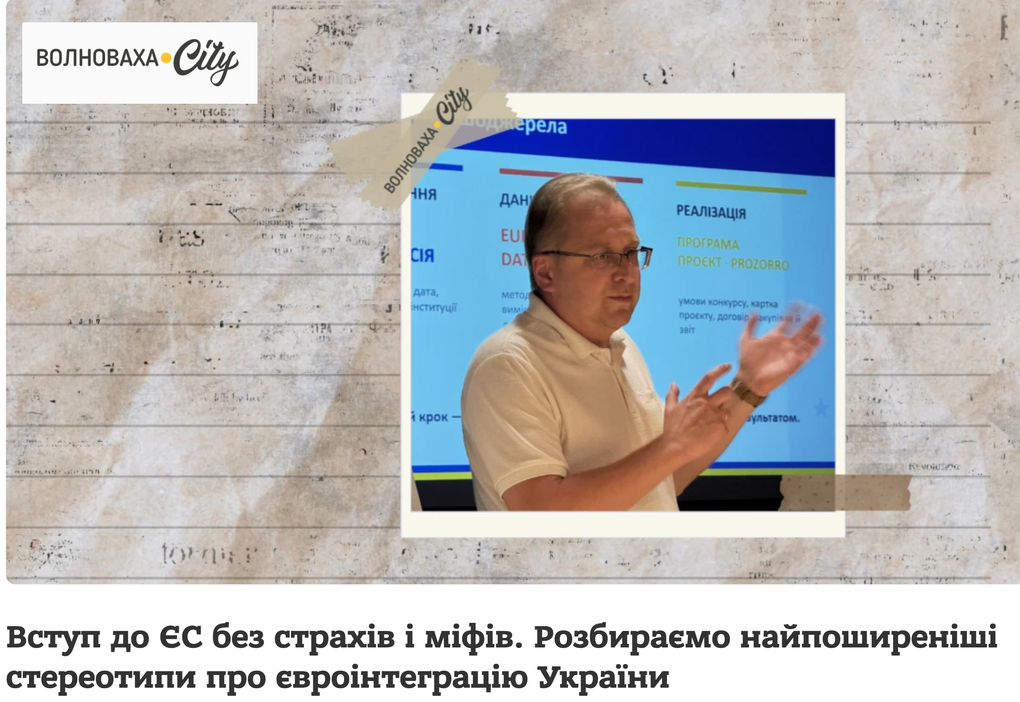
In ‘EU Accession Without Fears and Myths: Examining Common Stereotypes About Ukraine’s European Integration’, published by Volnovakha.City on 12 October 2026, journalist Anastasiia Kharina gathered explanations from Anatolii Shalaiev, Acting Director of the Association of Ukrainian Cities’ Lviv regional branch and an EU integration trainer for journalists. AUP prepared this independent editorial overview and checked the status of talks against official sources through CONNECT-EU (Communities, News, Networks for European Union), supported by Ukraine2EU.
Sovereignty: which decisions will be shared?
The fear that Brussels will make every decision for Ukraine oversimplifies how the EU works. Member states agree shared rules in specified areas and participate in adopting them. They retain their own state institutions and substantial national powers.
Ukraine is already aligning legislation with EU rules. Full membership would let it influence their development. It also entails obligations: in areas of EU competence, shared decisions must be respected.
Respect for member states’ national identities is enshrined in Article 4 of the Treaty on European Union. Discussions of sovereignty should therefore identify which powers belong to the EU and which remain national.
Land and business: what needs preparation?
EU membership is often associated with fears of foreigners buying Ukrainian farmland en masse. Future land-market conditions, regulation and possible transitional arrangements depend on legislation and negotiations. Membership alone does not answer every question.
For businesses, preparation means meeting product safety, environmental, competition and consumer protection standards. Anatolii Shalaiev explains that adaptation can be a substantial expense for small producers; larger businesses often find it easier.
Farms and small manufacturers need advice, training and financial support. Meeting standards can expand access to the EU single market, but benefiting requires resources to prepare.
Prices: why they will not align automatically
EU membership does not set Ukrainian prices at German or French levels. Prices depend on production, energy and delivery costs, taxation, competition and inflation.
New requirements may affect costs and prices in particular sectors. There is, however, no automatic mechanism aligning prices across all EU countries. Promising unchanged prices is as unfounded as predicting identical increases for every product.
The hryvnia and euro: a separate process
EU accession does not mean immediately abandoning the hryvnia. Adopting the euro requires meeting economic and legal conditions.
The European Commission explains that member states other than Denmark must adopt the currency once they meet the criteria. The Treaty sets no uniform timetable. EU accession and euro adoption dates should not be confused.
Communities: jobs, services and prepared projects
Wider opportunities to study and work abroad may intensify competition for skilled workers. For Ukraine, where full-scale war has already caused extensive forced migration, conditions encouraging return remain important: safety, affordable housing, jobs, good services and professional development.
Local government must prepare too. Communities need specialists able to plan development, prepare investment projects, manage funds transparently and attract international support. Infrastructure modernisation and better services depend on this everyday work.
Membership does not itself provide ready-made projects or staff capable of implementing them. Preparation needs resources from the planning stage.
Negotiations: what was open on 14 October 2026?
Ukraine has formally opened four of six negotiating clusters. At the accession conference in Luxembourg on 13 October 2026, talks opened on ‘Internal Market’ and ‘Competitiveness and Inclusive Growth’, according to the Council of the European Union’s announcement of 13 October 2026.
The ‘Fundamentals’ and ‘External Relations’ clusters opened earlier, on 15 June and 14 July 2026. The sequence appears in the Council’s overview.
Opening a cluster begins negotiations in the relevant areas. Closing them requires meeting benchmarks, adopting legislation and implementing reforms. Opening alone does not determine a membership date.
Checking claims about European integration
Claims that Ukraine will ‘lose independence’, ‘all businesses will close’ or ‘the hryvnia will disappear immediately’ should be checked against documents. Readers need to know which rules already apply, what remains under negotiation and what is a forecast or expert judgement.
Journalists must distinguish these categories and link to sources. A political agreement, for example, does not itself confirm a cluster’s formal opening; an official decision is needed.
AUP’s CONNECT-EU: European Integration for Every Community project supports primary-source research and explanations of reforms for local audiences. It brings journalists, trainers, experts and community representatives together to address integration, myths and manipulation.
In Volnovakha.City, Anatolii Shalaiev puts it this way:
‘Europe will not do our homework for us.’
Anatolii Shalaiev, Volnovakha.City
Preparation may mean compliance costs for entrepreneurs, recruiting specialists and developing projects for communities, and implementing reforms for public institutions. These tasks should be discussed with those responsible, explaining the support they need.
Original reporting
This is AUP’s independent editorial overview of ‘EU Accession Without Fears and Myths’, by Anastasiia Kharina, with expert Anatolii Shalaiev, Acting Director of the Association of Ukrainian Cities’ Lviv regional branch and an EU integration trainer for journalists. Published by Volnovakha.City on 12 October 2026.
All CONNECT-EU material is collected on the project page on AUP’s website.
About the organisers
AUP is one of Ukraine’s leading civil society organisations. For more than two decades, it has worked in journalism, media literacy and civic education, delivering large-scale projects across the country.
Ukraine2EU is a flagship European Union initiative supporting Ukraine’s preparations for accession and future EU membership.
This post was prepared with financial support from the Ukraine2EU Programme. The views and opinions expressed are the sole responsibility of the Academy of Ukrainian Press and do not necessarily reflect the position of the Ukraine2EU Programme or the European Union.
Translation note: This is a literary translation into British English, produced and proofread using a language model. Read the Ukrainian original.