Ukraine’s wartime resilience and European indices: Lauri Palsa on media literacy
Can a country that repels thousands of information attacks every day find itself near the bottom of international media literacy rankings? At first sight, it seems paradoxical. Yet this is Ukraine’s position in the Media Literacy Index 2026.
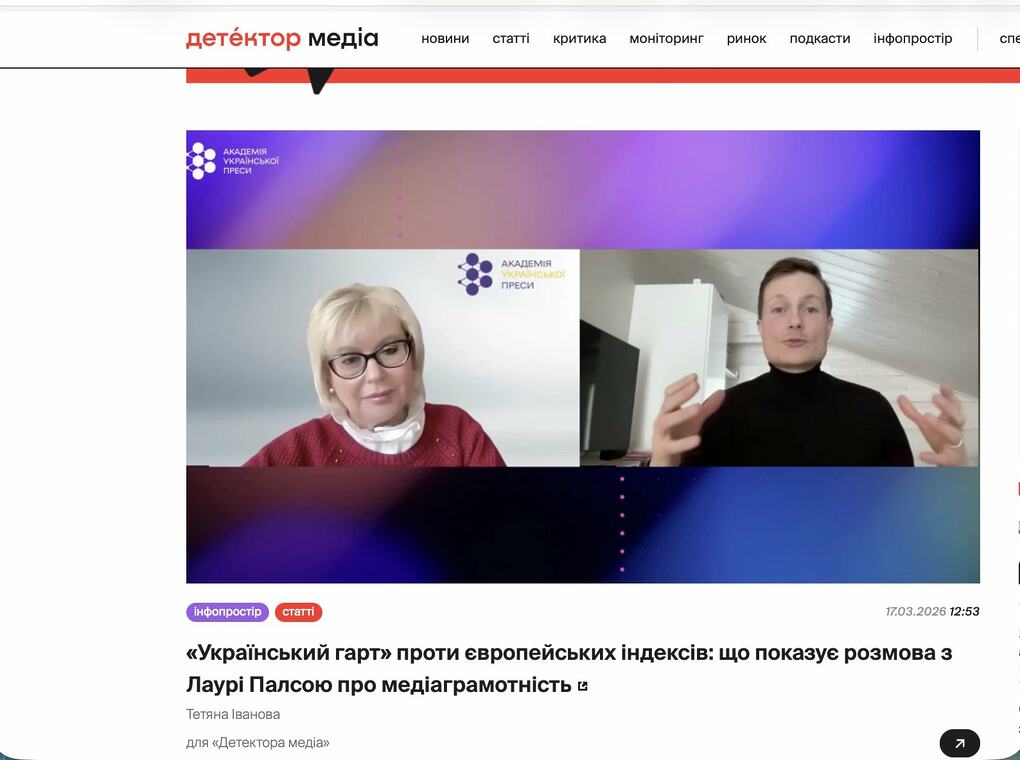
This question was central to our conversation with Finnish expert Lauri Palsa of the University of Jyväskylä. We wanted to understand what international indices actually measure, and why Ukraine’s experience of information resilience is not always reflected in the statistics.
According to the Media Literacy Index 2026, Ukraine scores 38 out of 100, placing it in the lower part of the ranking. Finland, by contrast, traditionally leads the list, with 71 points.
Source: https://ms.detector.media/trendi/post/39076/2026-03-17-ukrainskyy-gart-proty-ievropeyskykh-indeksiv-shcho-pokazuie-rozmova-z-lauri-palsoyu-pro-mediagramotnist/
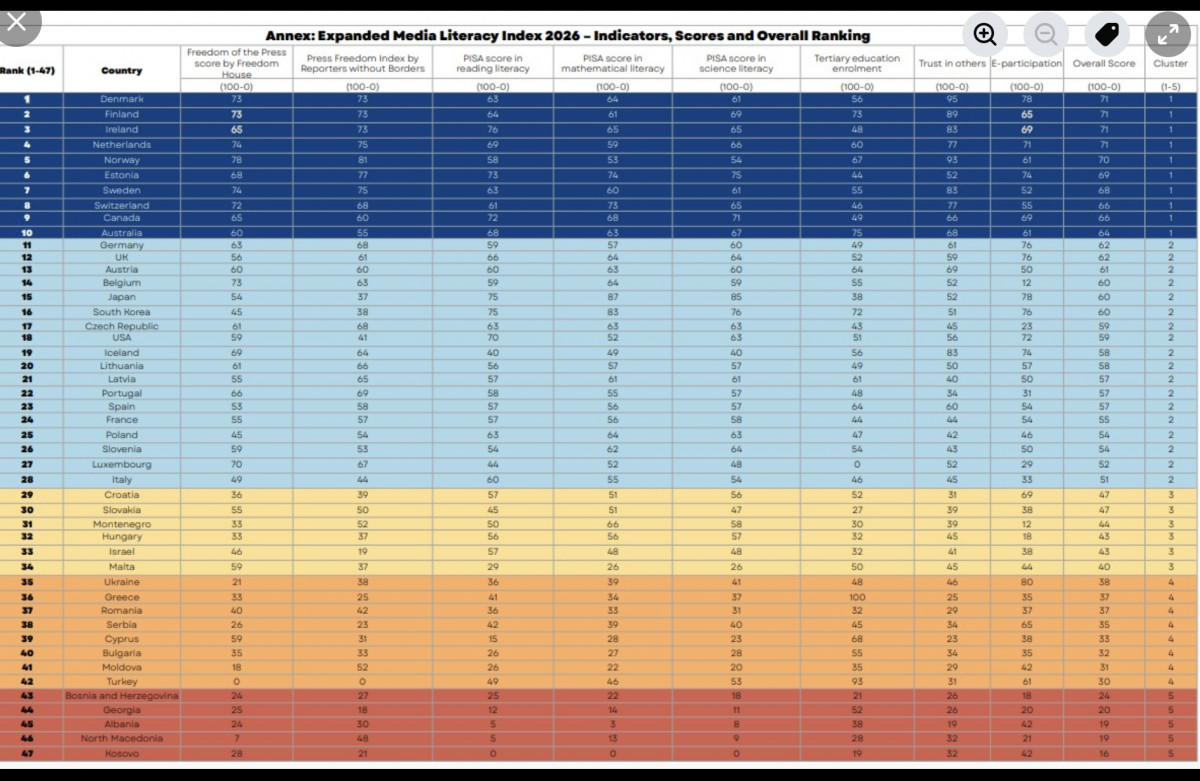
This might appear to indicate a substantial difference in societies’ media literacy. In the Finnish expert’s view, however, the index primarily measures the structural conditions for media literacy rather than people’s actual skills.
“The Media Literacy Index assesses people’s skills, but above all the environment in which those skills develop: education, media freedom and the level of trust in society,” Lauri Palsa explained.
In other words, the index measures the condition of the system more than individual competences.
What the index measures
The methodology primarily takes account of three factors:
- Media freedom.
- Results from PISA, the Programme for International Student Assessment, which examines how well 15-year-olds in different countries can apply their knowledge in practice.
- Social trust.
These indicators determine a country’s final position.
In Ukraine, war makes the situation considerably more difficult. It affects media freedom indicators and an education system operating under constant strain.
Ukraine nevertheless performs strongly in some areas. According to the V-Dem Institute, for example, civic participation in Ukraine is very high. This, too, is an important part of society’s information resilience.
Why, then, does Ukraine appear weaker in international statistics?
A detailed examination of the Media Literacy Index 2026 shows that its weighting favours underlying structural factors: 45% of the score depends on education and PISA results, and 40% on media freedom.
This is why the high positions of Denmark and Finland rest on the combined effects of institutional trust, stable education and sustained public policy on media literacy.
With 38 points, Ukraine falls into the fourth cluster. There is a tension here: formal academic measures produce a lower ranking, while society’s practical ability to resist propaganda is often considerably stronger.
Finland’s long-term model and Ukraine’s wartime experience
In our conversation with Lauri Palsa, we were effectively comparing two different models of media literacy development.
Finland’s model is systematic and long-term. Media literacy is integrated into almost every area of life, from education and libraries to government policy.
Lauri explained that Finland has been reviewing its national policy in this field since 2023, seeking to embed media literacy more deeply across social institutions.
“This is a task for the whole system, not just individuals,” he explained.
Ukraine’s model is different. Under the pressure of war, it operates in a more reactive way.
Ukrainians effectively take an informal media literacy course every day. Each information attack, fabrication or manipulation becomes part of continuous practice.
During our conversation, I drew Lauri’s attention to the fact that Ukrainians are living through an uninterrupted information “training course”. He agreed that Ukraine’s reactive model shows the world how critically important media literacy can become in an information war.
“When a society constantly encounters manipulation, it develops practical skills for recognising it very quickly,” Lauri Palsa commented.
Ukrainian research also supports this argument. Detector Media’s regularly measured Ukrainian Media Literacy Index shows consistently high levels of critical engagement with information.
According to the fifth wave of the study, covering 2020–2024, the proportion of the audience with “above-average” media literacy rose from 55% in 2021 to 81% in 2022, before stabilising at 72% in 2024. Read more about the study.
Despite information fatigue, key indicators remain high:
- 62% of Ukrainians consider disinformation a serious problem.
- 43% say they check information against additional sources.
International indices primarily measure institutional conditions, while domestic research records audiences’ actual behaviour.
Education, age and media freedom
Education was another factor we discussed. It accounts for 45% of the final Media Literacy Index score, so PISA results also matter here.
According to Lauri Palsa, 79% of pupils in Finland reach reading proficiency Level 2 or above, meaning they can identify a text’s main idea and distinguish facts from opinions. Ukraine’s figure is lower, creating a risk of greater vulnerability to complex information manipulation.
Adult media education is also developing in Ukraine. The Academy of Ukrainian Press contributes through programmes and training courses held since the beginning of the full-scale war.
Another telling figure is that, in 2025, 47.6% of participants in the national media literacy test were over 36. In my view, this suggests that the age gap in digital skills is gradually narrowing.
Media freedom is, of course, another influence on the index.
In 2025, Ukraine fell to 62nd place in the Reporters Without Borders ranking, but this was connected to the war. RSF Director Thibaut Bruttin explained that Russian aggression had dealt the principal blow to press freedom.
There is also the problem of media organisations’ economic instability. Around 90% of regional publications depend on international grants, while advertising provides only 3–10% of revenue. Without financial independence, journalism becomes more vulnerable to political or economic pressure.
Generative AI and the role of social trust
The development of generative artificial intelligence poses another challenge for media literacy.
The 2026 report describes AI as bringing a new phase of disinformation: such content is becoming more convincing and harder to detect.
According to Lauri Palsa, Finland is responding by developing psychological awareness, teaching people to recognise the emotional triggers used in manipulation. Ukraine, meanwhile, has effectively become a testing ground for new methods of recognising deepfakes.
Another conclusion Lauri Palsa draws concerns the social environment.
School, the Finnish specialist says, is only one part of the media literacy system. Family, friends and social connections are no less important. Disinformation spreads more slowly in countries with high levels of interpersonal trust, where people place more trust in verified sources and official institutions.
Institutional trust has historically been lower in Ukraine. But the war has produced a different phenomenon: horizontal trust. Volunteer and military networks have built social capital that is not always visible in international methodologies, yet it provides society with real resilience.
What can we learn from this comparison?
Our analysis of the Media Literacy Index and Finland’s experience led us to several conclusions.
First, international indices do not provide a complete picture of media literacy development. Institutional factors make Ukraine appear weaker, although in practice it demonstrates considerable capacity to resist disinformation.
Second, the next step should be to institutionalise media literacy. Finland’s experience shows that it needs to be integrated into public policy, from education to media economics.
Third, I am convinced that Ukraine’s experience is itself becoming an important international example. A society living through cognitive warfare develops new models of information resilience.
Media literacy today is therefore more than the ability to read news critically. It is the foundation of society’s information resilience: the “tempering” of Ukraine that demonstrates how a nation can withstand pressure on the information front even with middling statistical indicators.
Translation note: This is a literary translation into British English, produced and proofread using a language model. Read the Ukrainian original.