A false story does not end with a correction: how disinformation exhausts us
Picture an ordinary morning. Your phone is still on the bedside table, but your hand is already reaching for it. Telegram. Several new messages. An air raid alert. Photographs of destruction. Breaking news. Another channel reports the same thing, but slightly differently. We read, check and search for the original source. Open the official channel. Find a correction.
The story seems to be over. But is it?
Disinformation is usually treated as a problem of accuracy: true or false, fact or fiction, a genuine document or a forgery. For a long time, fact-checking was therefore considered the main answer to false information.
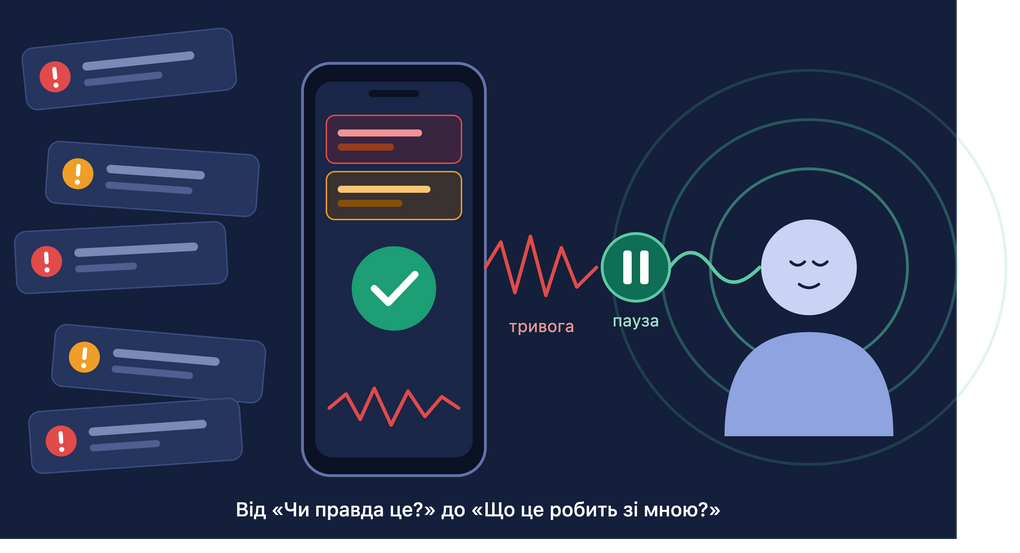
War, however, has exposed another side of the problem. A manipulative message may fail to convince someone yet still frighten them. It may not make them believe, but may make them check their feed every few minutes. It may be exposed and still leave anxiety, anger, helplessness or exhaustion behind.
A fabricated story can leave our opinion unchanged while changing how we feel. This is where the discussion of media trauma begins: the psychological mark that repeated or intense exposure to traumatic and manipulative media content can leave.
Disinformation is about more than falsehood
During training at the Disinformation Booster Academy, Nataliia Vyhovska, an expert on journalistic ethics and reporting sensitive issues, drew attention to disinformation’s psychological dimension. Her lecture explored how to recognise manipulative messages, but also what they do to people and their perception of reality.
This changes the focus. Saying ‘This is false’ answers just one question: whether the message reflects reality. At least three others remain: ‘What is this information doing to my emotions?’, ‘What is it prompting me to do?’ and ‘What stays with me after I discover it is untrue?’ The last question is often missing from the conventional model of media literacy.
You can disbelieve a story and still be affected
A study among higher education students in Sumy offers useful material here. It was a pilot survey, so its findings cannot automatically be generalised to the whole population or treated as a clinical diagnosis. They do, however, suggest a pattern.
For most respondents, the smartphone is their main digital tool, and Telegram is one of their main sources of war news. More than three-quarters said they checked the news or social media several times an hour.
Here is the paradox: someone may have adequate verification skills while remaining in a state of constant information-related tension.
More than half of those surveyed rated their fact-checking skills highly. Yet only a small proportion knew much about media trauma and information overload themselves. Recognising false information and protecting yourself from its psychological effects are not the same skill. This is perhaps one of the clearest reasons why contemporary media literacy needs to broaden its scope.
Fact-checking stops where the person begins
We tend to imagine fact-checking as an antidote: see a falsehood, check it, correct it, and the problem disappears.
The real information environment is more complicated. Someone reads a false report of a threat. They become frightened and forward it to loved ones. Ten minutes later, they find a correction and delete the message. They now know the truth. But their body has already experienced anxiety.
In the study, almost half of participants reported sharing alarming news in their own chats. Far fewer chose to take a break from information or turn to another activity.
Respondents also reported frequent anxiety and panic, difficulties with sleep and concentration, and emotional numbness.
This does not mean that every such symptom was caused by a particular false story. The pilot study cannot establish that causal relationship. It does raise an uncomfortable question: is teaching someone to verify information enough if we do not also teach them to notice when they have had too much of it?
The most dangerous content keeps us immersed in it
In her lecture, Nataliia Vyhovska also discussed her own experience of working in a toxic information environment. Constantly monitoring channels, accumulating shocking content and encountering repeated myths and manipulative narratives can exhaust even someone who understands disinformation professionally.
This matters particularly for journalists, editors, fact-checkers and media trainers.
Professional distance does not confer emotional immunity. A journalist may know perfectly well that a photograph has been taken out of context. A fact-checker may recognise an invented narrative. An editor may establish a video’s origin within minutes. That does not mean dozens of such messages a day leave no mark.
Media trauma literacy is therefore not only for audiences. People who work with toxic information every day need it too.
Not every false story needs to be repeated to debunk it
There is another professional trap. To refute disinformation, journalists have to repeat it, sometimes in detail.
But repeating a false claim can itself make the claim more familiar. An editorial decision should therefore begin not with ‘How do we produce an impressive debunk?’ but with ‘Do we need to reproduce this much of the narrative at all?’
Trauma-sensitive journalism adds another dimension to the traditional principle of accuracy: do no harm.
This applies beyond disinformation. When working with people who have experienced shelling, bereavement, captivity, violence or other trauma, journalists must consider the interviewee’s condition, the circumstances of the conversation and the possible consequences of publication.
A person is not simply a source of information. Sometimes the most professional decision is not to ask a question, even when the journalist technically could.
Media trauma literacy as the next step
Information security is no longer confined to whether someone can recognise a fabricated story. It also concerns their ability to retain critical thinking, act and relate to others under constant information pressure.
This is the subject of the fundamental research project The Concept of Media Trauma Literacy: Developing a Theory of Social Effect and Information Resilience, conducted by the Department of Journalism and Philology at Sumy State University.
The research examines information security, countering disinformation and strengthening Ukrainian society’s psychological resilience. It considers how people recognise manipulation, but also how information content affects their emotions, behaviour and ability to remain resilient.
The question changes fundamentally. We no longer ask only ‘Will someone believe this false story?’ We also ask: ‘What will happen to people, society and the information environment if millions see it?’
What to do after seeing a false story
The first step is not to demand that you immediately ‘stop reacting’. An emotion is not proof that manipulation has succeeded. Fear, anger or anxiety may be normal responses to an abnormal reality.
The second step is to name what is happening. ‘I’m angry.’ ‘I’m frightened.’ ‘I feel helpless.’ ‘I’m checking the feed for the tenth time.’ Simply naming a state redirects attention from an automatic reaction towards awareness of your own experience.
The third step is to set boundaries around information. The student study found that breaks, switching activities and consciously limiting the flow of information were underused responses to alarming news. A digital break is not an escape from reality. Sometimes it is a way of remaining able to take reality in.
Media literacy that starts with the person, not the false story
Conventional media literacy has taught us to ask the right questions: ‘Who said this?’, ‘What is the source?’, ‘What is the evidence?’, ‘Who benefits?’ and ‘What has been left out?’
We should now add several more: ‘What am I feeling?’, ‘Do I need to keep reading?’, ‘Should I share this content, even to refute it?’ and ‘Am I already experiencing information exhaustion?’
This is why researchers studying media trauma argue for complementing traditional media literacy with information hygiene, safer sharing skills, digital breaks and mutual support.
This does not mean fact-checking is no longer needed. Quite the opposite: it simply cannot be our only protection. A false story can affect both what we think and how we feel and behave. Fact-checking helps correct the first. The second requires media trauma literacy.
Perhaps the next stage of media literacy’s development lies in this shift: from ‘Is it true?’ to the broader question ‘What is this information doing to me, to others and to our shared information space?’
Disinformation does not end the moment we read the word ‘false’. Sometimes it leaves fear; sometimes mistrust, exhaustion or the wish never to read anything again. We need to recognise information poison, but we also need to learn not to let it determine our state of mind.
Nataliia Ponomarenko, PhD, Senior Lecturer in the Department of Journalism and Philology at Sumy State University, media trainer and member of the National Union of Journalists of Ukraine.
Translation note: This is a literary translation into British English, produced and proofread using a language model. Read the Ukrainian original.