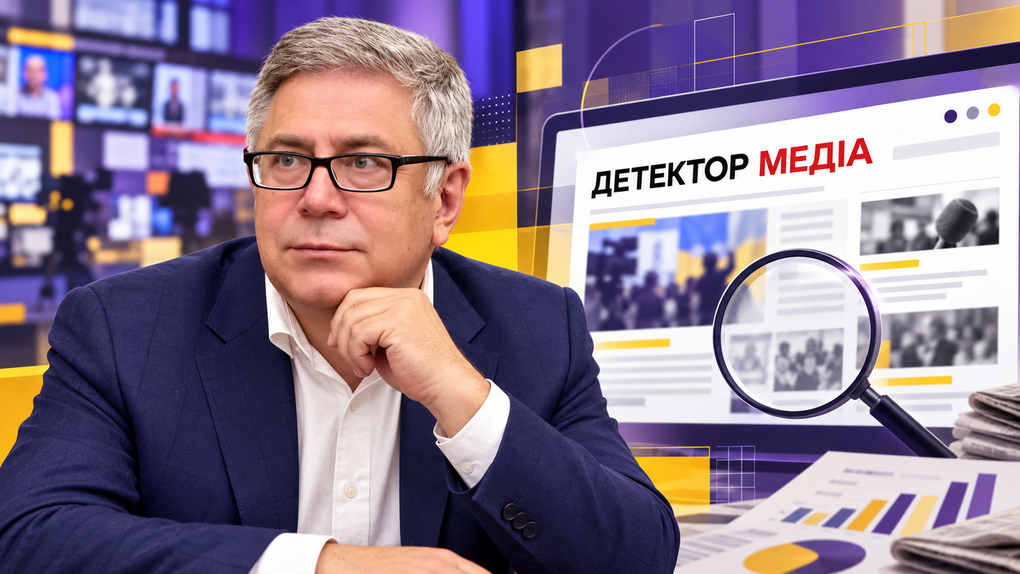
Valeriy Ivanov on 25 years of Detector Media: why media criticism must remain uncomfortable
Academy of Ukrainian Press President Valeriy Ivanov has reflected on 25 years of Ukrainian media criticism: from resisting centrally issued editorial instructions and political censorship to scrutinising standards during the full-scale war and examining the influence of algorithms and artificial intelligence. This article draws on Svitlana Ostapa’s interview for Detector Media, prepared for the outlet’s 25th anniversary.
For Valeriy Ivanov, the history of Telekrytyka, later Detector Media, is more than the story of one professional publication. It reveals how Ukrainian journalism and civil society matured, how newsrooms learnt to call censorship censorship and covert paid coverage dzhynsa, and why scrutiny of professional standards matters even when the country is at war.
How media criticism changed Ukrainian journalism
In the late 1990s and early 2000s, Ukrainian media gained new opportunities while becoming dependent on major owners. Journalists found themselves caught between professional rules, political interests and the demands of the media business. Then came temnyky: centrally issued instructions specifying what television channels should report and the tone they should adopt.
Media criticism began acting as a mirror for the profession. It examined not just what the media reported, but how they set the agenda: whom they invited on air, whose statements went unchecked, which subjects they ignored and where advertising or political PR passed for news.
In Ivanov’s assessment, Nataliia Lyhachova’s early articles stood out for their attention to audiences’ interests. Reasoned criticism exposed mechanisms that people had previously preferred not to discuss publicly. Readers might disagree, but it demanded a substantive response.
From analysing content to changing media institutions
Telekrytyka’s role went beyond examining television news. It consistently supported reforms without which quality journalism could not become sustainable: updated media legislation, the removal of state ownership from the press, transparency of media ownership and an independent public broadcaster.
Public service broadcasting remained on the agenda even during years when political will for reform was almost absent. That persistence demonstrates a wider function of professional criticism: recording violations, but also explaining which rules and institutions could prevent them.
Three tests for Ukrainian media
The Orange Revolution. In 2004, Telekrytyka became a platform for journalists resisting political pressure. It published their statements and testimonies while continuing to scrutinise whether the protesters themselves upheld professional principles. Solidarity did not become an automatic excuse for ‘our side’.
The Revolution of Dignity. Daily analysis of television coverage of Maidan showed that a journalist’s civic stance did not remove the requirements of accuracy, balance and separating fact from judgement. Monitoring findings informed professional debate and the examination of breaches of standards.
The full-scale war. After 24 February 2022, Russian disinformation as an instrument of war added to existing risks. Ivanov nevertheless stresses that wartime circumstances must not turn ‘now is not the time’ into a blanket ban on criticism. Monitoring the television news marathon, political PR, unreported topics and breaches of standards is necessary precisely so that democratic journalism survives the war.
This position echoes AUP’s President’s other public statements on journalism during wartime and the limits of permissible restrictions: security measures may be necessary, but they must be clear, justified and accountable.
Why genuine media criticism can irritate
Ivanov acknowledges that Telekrytyka could often be irritating. Perhaps that is a sign of genuine media criticism. Professional criticism loses its purpose if it merely confirms readers’ views or serves one group’s sympathies.
He identifies the team’s most important quality as a willingness to stand by its principles even at a cost: asking uncomfortable questions not only of those in power or one’s opponents, but also of people and organisations with whom one shares democratic values. That is a more demanding standard than simply being oppositional. It requires applying the same rules to everyone and being prepared to admit mistakes.
Media criticism should therefore not become conflict for attention’s sake. Its foundations are evidence, transparent methods, an understanding of context and respect for audiences. It can be sharp, but must remain professional.
A new focus for scrutiny: algorithms, platforms and AI
In the coming years, scrutiny will need to extend beyond newsrooms, television channels and their owners. Recommendation algorithms on TikTok, YouTube, Telegram and other platforms increasingly stand between people and information. They determine what users see, how long they stay with a message and what they encounter next.
Generative AI adds further complexity. Some messages no longer have a conventional author or editor, and the origins of text, images or video may be unclear. Contemporary media criticism must therefore examine the whole information ecosystem: editorial decisions, platform business models, algorithms, the labelling of synthetic content and the responsibility of those who distribute it.
Audiences face a new set of questions: why did this item appear in my feed? Who benefits from its circulation? Which data informed the recommendation? Can I identify the author and original source? Is AI use disclosed?
What Ivanov’s position means for media education
For the Academy of Ukrainian Press, professional standards, media criticism and media literacy are interconnected. Journalists need external, reasoned assessments of their work. Audiences need tools to understand how the media select and construct a picture of the world.
Media education must therefore go beyond recognising individual fabricated stories. It needs to explain editorial processes, the difference between journalism and political promotion, the influence of ownership, the role of public service broadcasting and the logic of platforms. This wider perspective allows people to assess both a message and the environment in which it was produced.
Media criticism should not be comfortable, Ivanov concludes. Its public value begins where it prevents the profession from becoming accustomed to violations and audiences from treating the media’s picture as a neutral reflection of reality.
This article is AUP’s editorial compilation based on Svitlana Ostapa’s interview. The full text, including Ivanov’s answers and archive photographs, was published by Detector Media on 28 September 2026. This publication uses paraphrase, analysis and brief quotations, with attribution to the original source.
Translation note: This is a literary translation into British English, produced and proofread using a language model. Read the Ukrainian original.