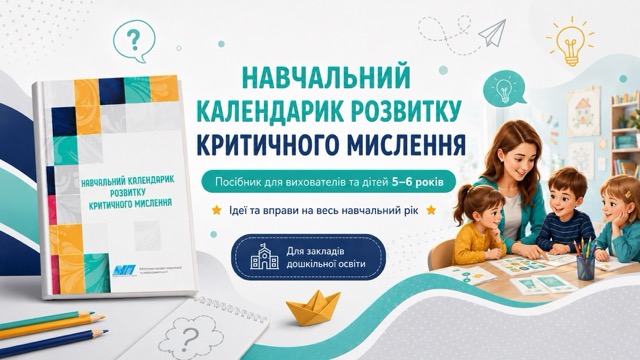
A Critical Thinking Learning Calendar: a practical handbook for children aged 5–6
The start of a new school year is a chance to bring fresh ideas, exercises and activities into preschool sessions: tasks that engage children while helping them learn to think for themselves.
The Academy of Ukrainian Press highlights A Critical Thinking Learning Calendar, a practical workbook supporting critical thinking in children aged 5–6. It encourages curiosity, attention, analysing information, asking questions and drawing one’s own conclusions.
The handbook is intended primarily for preschool educators, teaching advisers and teachers, as well as parents seeking engaging, purposeful activities to prepare children for school.
Ideas and exercises for the whole school year
The Learning Calendar is organised as a calendar covering a school year. It collects exercises and teaching approaches for older preschool children.
The materials are grouped by theme, but teachers do not have to follow a rigid sequence. Exercises can be:
- Selected to suit a particular session’s topic.
- Combined with one another.
- Used in a different order.
- Used independently of a particular month.
- Adapted to a group’s needs and pace.
The handbook can become a collection of ready-to-use ideas whenever educators want to vary a session, introduce a new activity or find a task that prompts children to think and seek answers rather than simply keeping them occupied.
Why develop critical thinking before school?
For a child, critical thinking begins with curiosity about the world, not complicated theories or terminology:
- Why does this happen?
- How do we know?
- What happens if we do it differently?
- How are these objects similar, and how are they different?
- Which option might be right, and why?
Through play, observation, comparison, discussion and simple exploratory tasks, children gradually learn to make sense of information rather than merely receive it.
These skills matter particularly before starting school. They provide foundations for later learning: attentiveness, independence, the ability to explain an opinion and the desire to look for answers.
Who will find the handbook useful?
The Learning Calendar is recommended for work with older preschool children aged 5–6. It will help:
- Nursery and preschool educators looking for additional exercises and approaches for everyday sessions.
- Preschool teaching advisers planning activities and broadening their range of educational tasks.
- Teachers preparing children for their first year of school who need supplementary material for thinking and cognitive skills.
- Parents of children about to start school seeking purposeful activities at home through play and shared exploration.
More than ‘something to keep a child busy’
When adults look for interesting preschool tasks, educational value matters alongside enjoyment.
Critical thinking exercises combine the two. Children enjoy a task while adults help them observe, compare, analyse, suggest explanations and justify their views.
Educators also gain a selection of resources from which they can choose an exercise to suit the session’s topic, the situation or the children’s interests.
Preparing for school through engaging tasks
The handbook is particularly relevant at the start of a school year, both for older preschool groups and for sessions with children preparing to start school.
School readiness involves more than reading, writing and counting. Listening, asking questions, noticing details, finding connections and explaining choices are equally important.
These skills help children feel more confident in a new learning environment.
About the handbook
- Author: Nataliia Stepanova.
- Publishers: the Academy of Ukrainian Press and the Free Press Centre.
- Publication year: 2020.
- Length: 73 pages.
- Audience: children aged 5–6, educators, teaching advisers, teachers and parents.
For broader preschool media education work, see AUP’s Media Literacy and Critical Thinking in Preschool Education.
Download it and use it in your work
The Learning Calendar was created by the Academy of Ukrainian Press and is available electronically.
Save a copy, share it with colleagues and use the exercises throughout the school year.
We hope it gives educators plenty of ideas for engaging sessions and children more opportunities to ask questions, explore, think and find their own answers.
Download A Critical Thinking Learning Calendar.
Translation note: This is a literary translation into British English, produced and proofread using a language model. Read the Ukrainian original.