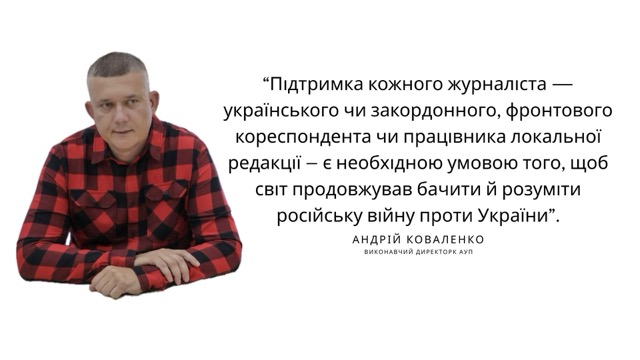
Supporting every journalist is essential to keep Russia’s war against Ukraine visible, says Andrii Kovalenko
Supporting every journalist – Ukrainian or international, a frontline correspondent or a local newsroom colleague – is essential if the world is to keep seeing and understanding Russia’s war against Ukraine. A meeting at the National Union of Journalists of Ukraine explored media workers’ safety, international solidarity and new challenges facing the profession.
Mika Beuster, Chair of the German Journalists’ Association (DJV), Dr Wolfgang Ressmann, coordinator of the Media Dialogue project, and Xhabir Deralla, President of North Macedonia’s CIVIL – Center for Freedom, visited Kyiv. Together with Ukrainian colleagues, they discussed how the full-scale war has changed journalism, the greatest current threats to reporters and the support Ukrainian media need.
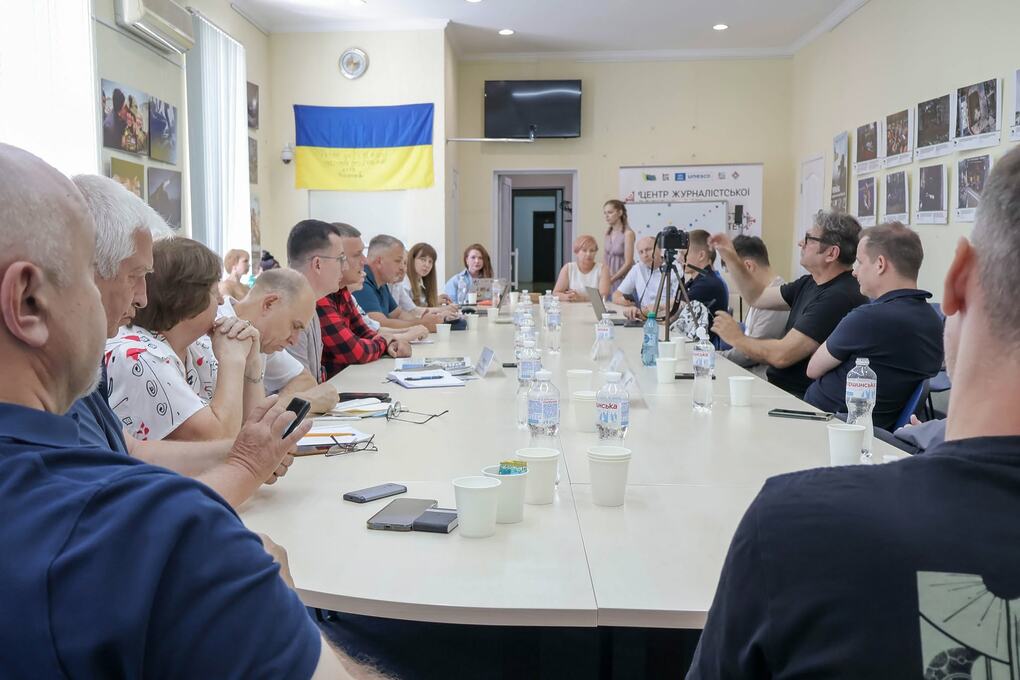
NUJU Information Service.
NUJU President Sergiy Tomilenko stressed that international partners’ questions help explain more precisely the reality in which Ukrainian journalists work. Support must be practical rather than declarative: protective equipment, drone detectors, psychological recovery, assistance for local newsrooms and sustained international attention to journalists unlawfully detained by Russia.
Solidarity in practice
The meeting separately addressed the 28 civilian journalists whom, according to figures cited by Tomilenko, Russia is unlawfully holding captive. Former Kremlin political prisoner Vladyslav Yesypenko suggested that international colleagues become media ambassadors for imprisoned journalists, giving each person’s story a voice in the world’s media.
War reporter Yuliia Surkova highlighted journalists’ psychological resilience. Reporters return from frontline assignments with stories, but also with experiences that require professional reflection and recovery. Psychological programmes and retreats should therefore be as important a part of support as body armour, helmets and other protective equipment.
The meaning of a safe distance is changing too. Journalists increasingly borrow drone detectors from Journalists’ Solidarity Centres, returning them after assignments so other colleagues can use them. This mutual assistance, support for frontline newsrooms and professional exchange have become important to the Ukrainian media community’s resilience.
‘For Russia, a journalist is a witness’
War reporter, international media producer and AUP Executive Director Andrii Kovalenko attended the meeting. He stressed that warfare’s technological transformation requires constant reassessment of safety rules:
‘The war we worked in during 2022–2024 and the war we work in today are no longer the same war. It has become a war of technologies. The front increasingly resembles scenes from Mad Max and Star Wars at once. The main threat no longer comes only from the ground: it is constantly overhead. A location that was safe yesterday can become deadly in an instant. A road that was passable half an hour ago may already be under drone control. A PRESS marking does not stop an FPV drone. Body armour will not save you from a direct hit. A helmet will not protect you from a badly chosen route. To a Russian drone operator, a journalist is a priority target on a screen. For Russia, a journalist is not merely an observer. A journalist is a witness. And Russia fears witnesses to its crimes. A drone detector does not shoot down a drone, but it provides the most precious thing: time. In drone warfare, reaction time often decides everything. Safety is not only equipment. Safety is also making the right decision.’
His words describe a fundamentally changed reality: PRESS markings no longer guarantee protection, and aerial threats can arise far from a notional frontline. Equipment remains essential, but its effectiveness depends on preparation, up-to-date risk assessment, route planning and the speed of decision-making.
The Academy of Ukrainian Press’s role
Supporting journalists working in Ukraine and telling the world about it is practical, sustained work for AUP. The Academy combines journalism and media education expertise with wartime experience: producing learning resources, holding professional discussions and safety training, and helping international media workers understand Ukraine’s context and conditions on the ground.
A practical part of this is sustained support for local newsrooms. AUP’s website documents how Holos Huliaipillia, Trudova Slava in Orikhiv and Pivdenna Zoria in Nikopol maintain communities’ access to verified information under constant shelling.
Mentoring is an important part of this support. AUP journalist and media trainer Andrii Yurychko helps local media improve their visibility in search, develop digital platforms and work more effectively with social media. His mentoring of frontline newsrooms helps them adapt to digital change, strengthen audience relationships and explore opportunities for sustainability.
Since the full-scale invasion began, Kovalenko has worked with more than a hundred international journalists, travelled tens of thousands of kilometres along frontline roads and helped the world’s media document the consequences of Russian aggression. This experience enables AUP to connect Ukraine’s professional community with international newsrooms.
Support must extend to everyone reporting honestly and professionally about Ukraine: Ukrainian journalists who stay with their communities and work at the front, and international colleagues who bring Ukrainian testimonies to audiences abroad. Every safely prepared, accurately reported story strengthens international understanding of Ukraine and prevents Russia from concealing its crimes.
Journalists matter. Their safety, professional resilience and right to keep bearing witness matter. Solidarity between Ukrainian and international media organisations must therefore remain sustained, practical and shared.
Based on NUJU President Sergiy Tomilenko’s Facebook post.
Translation note: This is a literary translation into British English, produced and proofread using a language model. Read the Ukrainian original.