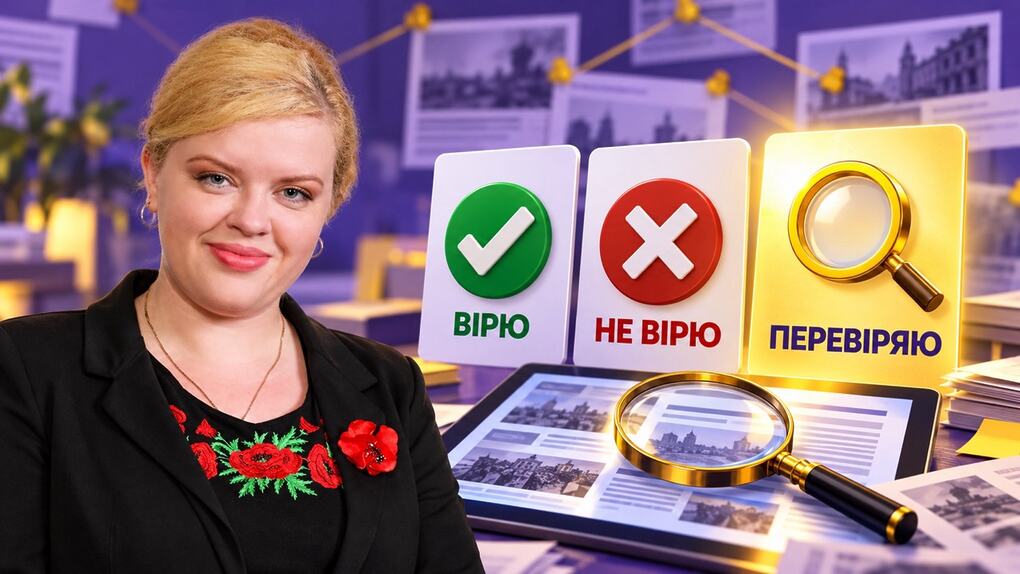
‘I Believe, I Don’t Believe, I Check’: an interactive media literacy exercise
‘I Believe, I Don’t Believe, I Check’ is an interactive media literacy exercise that teaches participants to explain choices and examine evidence rather than guess whether a message is true. After each answer comes the most important part: participants defend their views, ask questions and work with the trainer to establish what is missing before a conclusion can be reached.
The authors, Tetiana Ivanova and Nataliia Ponomarenko, presented it at AUP’s ‘Filter Information, Create Change: Trainers’ Laboratory. A Hackathon of Practices’. The series comprised five two-day online courses involving 109 media literacy trainers.
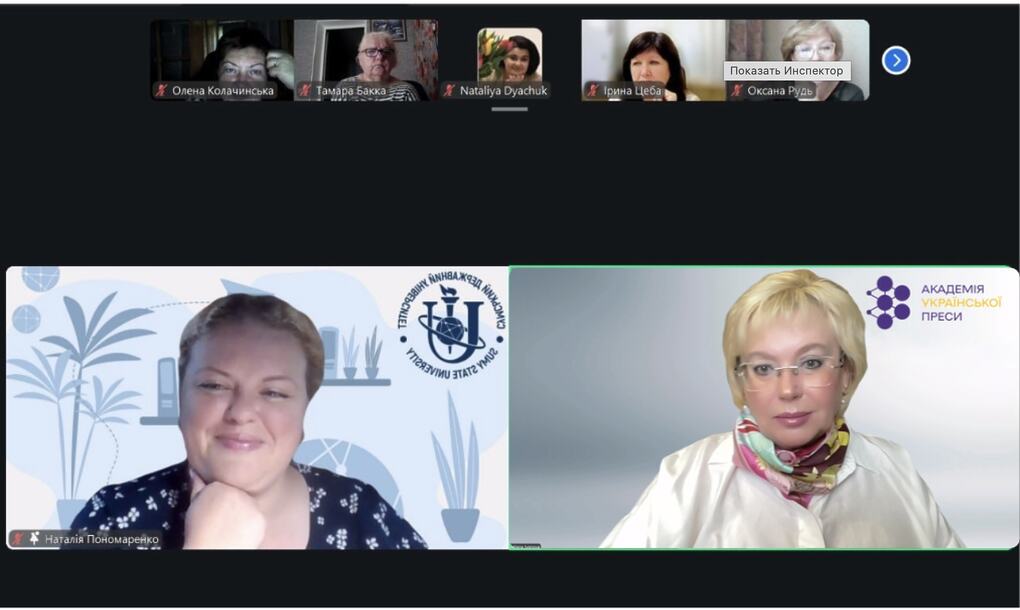
Tetiana Ivanova and Nataliia Ponomarenko during an AUP online training session.
Media literacy without guessing
The exercise is straightforward. Contemporary messages appear on screen: Telegram posts, news reports, messages supposedly from a bank, videos of unknown origin and information from official resources. Participants choose ‘I Believe’, ‘I Don’t Believe’ or ‘I Check’.
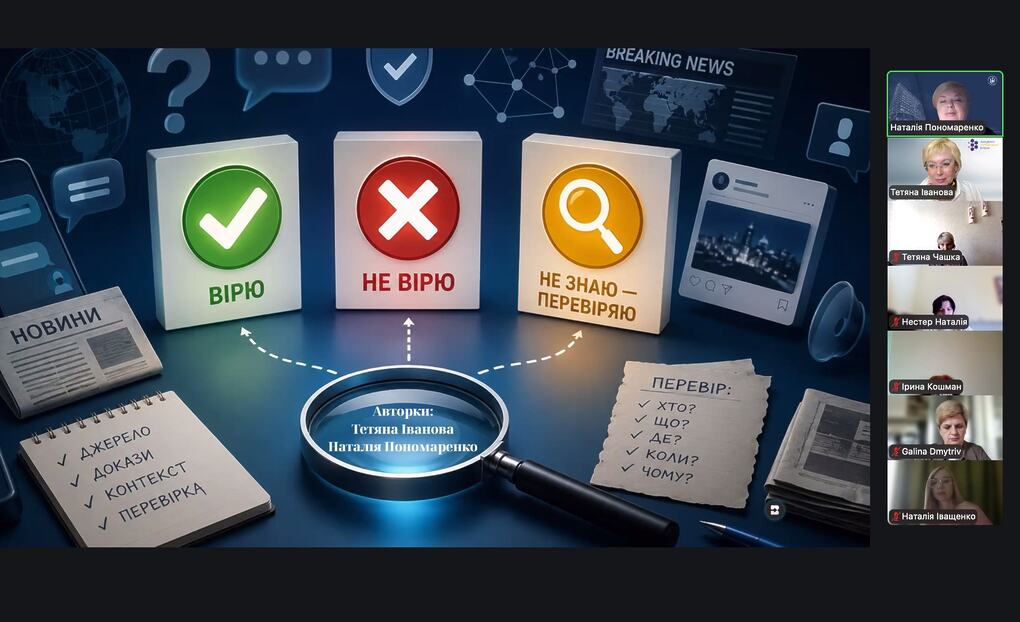
Three possible information decisions in ‘I Believe, I Don’t Believe, I Check’ during AUP’s online training.
The task is not to divide messages rapidly into true and false. Participants identify the evidence available, information missing and whether a reasoned conclusion is possible. ‘I Check’ is particularly important: it acknowledges uncertainty and postpones judgement until reliable information is available.
Co-author Nataliia Ponomarenko is a media trainer and lecturer in Journalism and Philology at Sumy State University with more than thirteen years’ experience. She works on critical thinking, fact-checking, information hygiene and contemporary media education methods. Since 2018, she has participated in IREX’s ‘Learn to Discern’ media literacy programme. She co-authored ‘Media Capsules’ and the ‘Multimedia Dictionary of Media and Information Literacy’ and won Ukraine’s national media literacy training competition in 2025.
Her cooperation with AUP spans several years. Archive photographs recall earlier in-person projects, different audiences and experiments with teaching methods. This exercise continues that practice online.
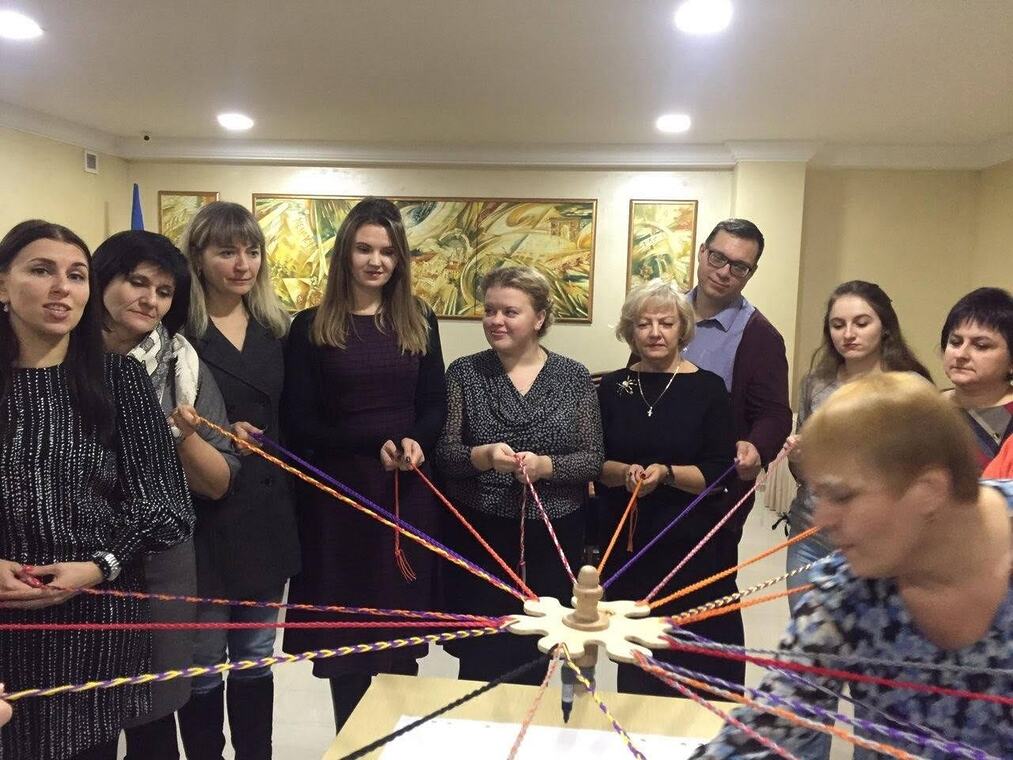
Archive photograph: practical work at an in-person media literacy training.
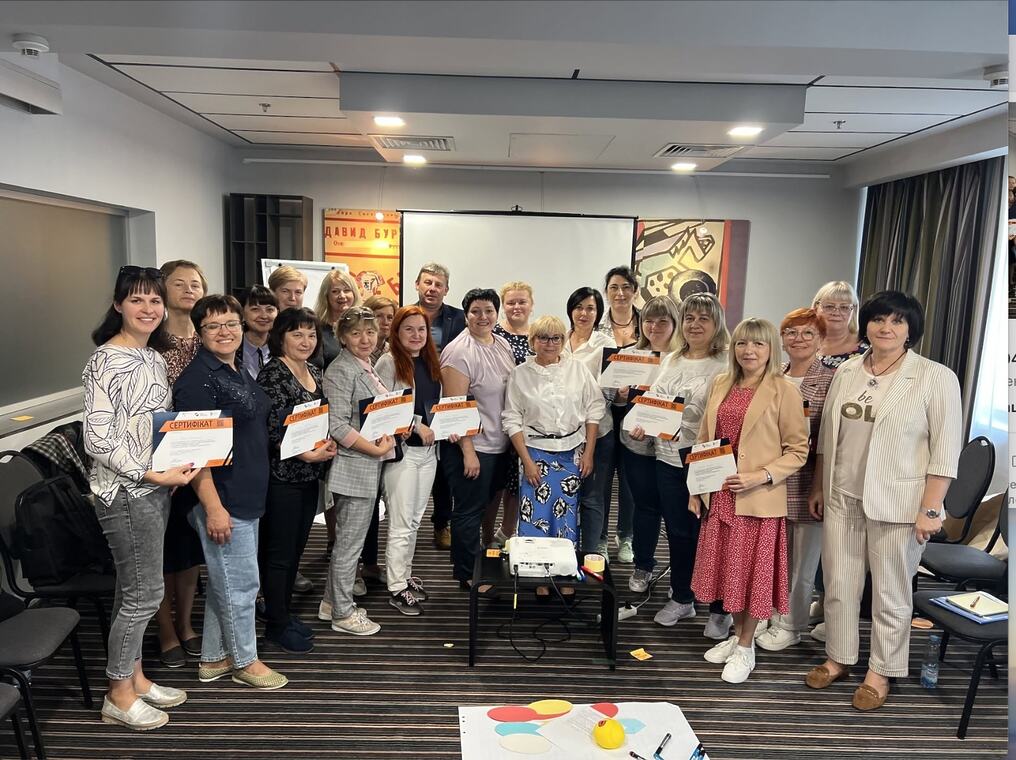
Archive photograph: participants at an educational event, another chapter in a longstanding training partnership.
How the Canva exercise works
Participants do not vote through a separate form or chat. Using Canva’s drawing tool, they mark choices directly on a shared slide. Ticks, lines and other symbols appear in real time, mapping the group’s decisions.
The trainer immediately sees agreement and division. Instead of automatically marking answers right or wrong, she asks: ‘Why did you choose that?’, ‘What made it trustworthy?’, ‘What is missing for verification?’ and ‘What might change your view?’
The digital tool makes positions visible. They then become material for critical analysis as the group compares arguments, clarifies concepts and checks whether the facts support a conclusion.
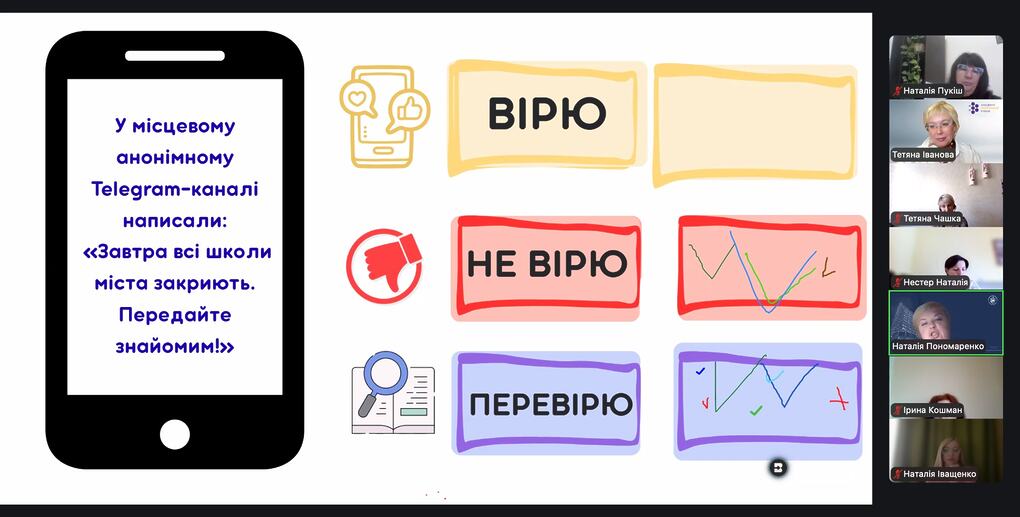
Participants mark choices directly on the Canva slide. Different answers begin a discussion.
Distinguishing a mistake from manipulation
The cases extend beyond obvious false stories. In one, a journalist gives an incorrect event date; after readers raise it, the newsroom corrects the report and explains the change. Does the mistake make the whole outlet unreliable? Or does acknowledging and correcting inaccuracies demonstrate editorial responsibility?
Another case concerns manipulative generalisation. A headline claims residents ‘categorically refused’ to support evacuation measures, although only twelve of 100 surveyed objected. A minority’s view becomes everyone’s position.
Other examples include a purported bank message demanding card details and an SMS code urgently; shelling footage without an identifiable author, date or origin; and repeated unsupported accusations. Participants distinguish fraud, manipulation, propaganda, accidental error and insufficient information.
The teaching principle is simple: a suspicious message is not necessarily false, an emotional headline does not always contain an untruth, and official material also requires careful reading and contextual comparison.
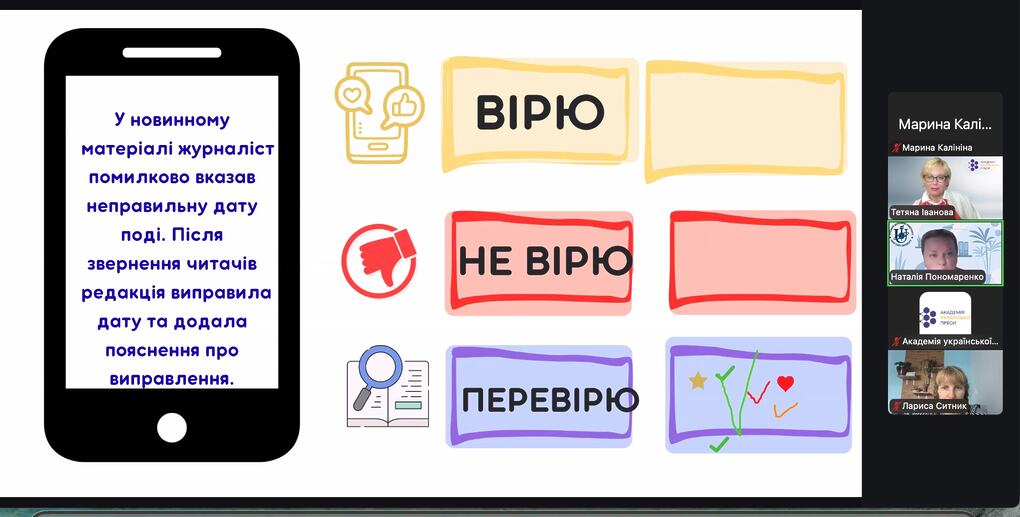
Discussing a case: a sound choice requires reasoning rather than an intuitive verdict.
The trainer’s role in discussion
During piloting, Nataliia Ponomarenko’s professional skill was evident in her handling of discussion. Having worked together on ‘Critical Thinking During Political Elections’, we know her ability to listen and build the next question from participants’ answers. A strong trainer examines the reasoning behind answers as well as whether they are correct.
When participants simultaneously choose different options, there is no predetermined script for the next minute. The trainer must respond to arguments, hear doubts, notice flawed logic, ask precise follow-up questions and help the group reach a conclusion. This requires broad knowledge, teaching intuition and a capacity for dialogue.
AI already helps trainers produce material, examples, tests and presentations. A digital tool cannot replace sound teaching methods and professional debriefing. In live discussion, a trainer responds to a particular group’s unpredictable dynamics, clarifies arguments and chooses questions for the situation.
Discussion was central to the exercise, not an addition. Participants had room for their own views, but each answer needed evidence or an explanation of what information was still missing.
Debriefing turns activity into learning
A correct mark on a slide does not establish understanding. An answer can be guessed or copied from the majority. Explaining the reasoning reveals whether a decision rests on evidence, emotion, source authority or familiarity with a format.
After each situation, the trainer therefore organises discussion rather than rushing to reveal an answer key. Participants compare positions, examine mistakes and formulate rules applicable outside training.
Final reflection uses unfinished sentences: ‘A reliable source is…’, ‘When evidence is insufficient, I can say…’, ‘A mistake differs from manipulation because…’, ‘Before sharing, I will check…’. This helps participants turn experience into their own approach to information.
What the exercise teaches
‘I Believe, I Don’t Believe, I Check’ shows how a simple Canva tool can support a methodologically rich session. The shared slide involves the whole group; discussion moves it from initial reactions towards reasoned judgement.
Success is not measured by correct marks alone. More important is whether someone will ask a question, identify missing evidence, hear another view and revise a conclusion when needed.
Critical thinking begins with a simple step: resist rushing, state your grounds and check whether they stand up against the facts.
Other FreeMind Ukraine exercises and resources
- Svitlana Bohdziievych’s ‘Information Bubble’: social media algorithms and critical thinking.
- Iryna Tseba and Svitlana Vorontsova’s ‘Media Detectives’: information operations, false stories and manipulation.
- Halyna Dehtiarova’s ‘A Place for the Dragon’: how media construct reality.
- ‘Filter Information, Create Change’: Tetiana Ivanova’s exercise collection.
News, exercises, handbooks and other resources are collected on the FreeMind Ukraine project page for participants, educators, media trainers and anyone interested in media literacy and critical thinking.
The exercise was presented through FreeMind Ukraine. AUP’s project partner is the Centre for Media and Digital Literacy (CeMIL) at Freie Universität Berlin’s Institute for Media and Communication Studies in Germany.
Translation note: This is a literary translation into British English, produced and proofread using a language model. Read the Ukrainian original.