A Place for the Dragon: Halyna Dehtiarova’s exercise on how media construct reality
In ‘A Place for the Dragon’, two newsrooms receive the same fact – a dragon has appeared near the principality – and produce opposing reports. Halyna Dehtiarova, Doctor of Pedagogical Sciences, Professor and media trainer, developed the exercise. Working with Yurii Vynnychuk’s novella reveals how media owners’ interests, selection of facts, language and images shape perceptions.
Contents
- The trainers’ laboratory
- Halyna Dehtiarova’s original exercise
- One event, two editorial realities
- Who decides who the ‘dragon’ is?
- Manipulation without outright lies
- Using the exercise
- Perhaps the dragon is no dragon at all
- About FreeMind Ukraine
The trainers’ laboratory
‘Filter Information, Create Change: Trainers’ Laboratory. A Hackathon of Practices’ combined learning and an exchange of methods among Ukrainian media trainers. For more than fifteen years, AUP has developed media literacy and trained over 1,100 trainers.
Participants delivered original exercises, analysed them and suggested adaptations. Each was followed by joint debriefing. The five two-day online courses involved 109 trainers. Read AUP’s report on the series.
AUP is publishing activities discussed and tested in the laboratory. They can be used in full or adapted to a group’s age, experience and learning needs.
The first was Svitlana Bohdziievych’s ‘Information Bubble’, exploring algorithms, source selection and information hygiene.
Halyna Dehtiarova’s original exercise
Halyna Dehtiarova is a Doctor of Pedagogical Sciences, Professor, highest-category teaching-methods specialist and AUP media trainer. She combines language and literature teaching with media education.
She co-authors and edits AUP teaching publications, including ‘Practical Media Literacy in the New Ukrainian School: Grades 5–7’, which integrates media education into different subjects.
She chose Yurii Vynnychuk’s novella ‘A Place for the Dragon’. Fiction creates room to examine mechanisms that provoke fierce disputes in real life: editorial dependence on owners, stereotypes and the construction of an enemy.
One event, two editorial realities
The starting point is simple: a dragon appears near the principality, and newsrooms must report it. Divide participants into two teams.
- Public broadcaster ‘Liubotyn TV’ presents Hrytsko the Dragon as a poet and Christian.
- ‘The Prince’s TV’, owned by Liubotyn’s prince, presents the Dragon as a danger to residents.
Both cover one event but receive different assignments. Before the first sentence is written, decisions have been made about which qualities to emphasise and which audience response to seek.
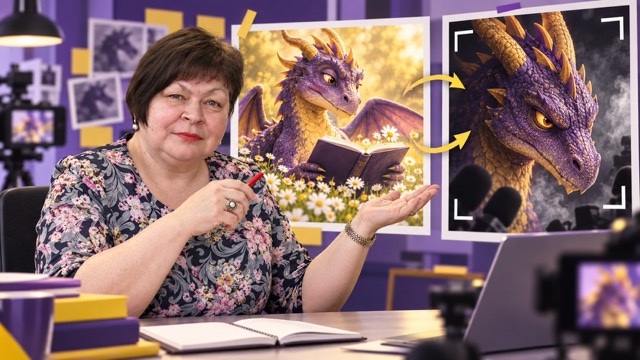
Teams also use AI tools to create images of Hrytsko, drawing on the novella’s description or their own interpretation. The discussion compares text and visual choices: colour, angle, expression, surroundings and details suggesting how viewers should feel.
Who decides who the ‘dragon’ is?
Halyna begins by asking teams to define their editorial conditions. Who sets the assignment? Is impartial reporting possible? How does coverage change when an owner wants a particular version?
Hrytsko is unlike a conventional monster. He writes poetry, reads the Bible, grows flowers and wants to harm nobody. Yet residents are offered another logic: a dragon’s appearance must mean danger; danger requires an enemy to defeat.
Participants return to their reports and locate the construction of danger: a headline, quotation, omitted detail or image. They also examine ownership, audience fear, crowd psychology and repetition of one interpretation.
Manipulation without outright lies
When teams present, their reports are placed side by side. Participants see that manipulation need not invent a fact. It can omit information, reorder details, add an emotional word or show someone from a chosen angle.
The exercise develops several skills: separating fact and interpretation, recognising ownership’s influence, analysing words and images, and tracing stereotypes. Generative AI adds another question: what responsibility lies with the person writing a prompt and selecting an output?
Tolerance becomes a specific action too: pausing before judgement and checking who labelled another person ‘foreign’, ‘dangerous’ or ‘an enemy’, and on what grounds.
Using the exercise
The activity combines literary analysis and news production. It suits Ukrainian literature lessons, media literacy classes and training for educators, young people and communities, including journalism and education students.
Online teams can use breakout rooms and present on a shared screen. In person, split participants into two newsrooms with separate assignments. Discussion length depends on experience. Younger groups may focus on stereotypes and imagery, adults on ownership and editorial responsibility.
The trainer does not announce beforehand which newsroom is right. Conclusions emerge from comparing reports and examining the decisions behind them.
Perhaps the dragon is no dragon at all…
A question remains beyond the novella: how much of our view of people and events comes from experience, and how much arrives packaged in a headline and image?
Halyna’s exercise examines the route from fact to media message. Along that route, someone chooses a topic, selects details, names the protagonist and decides whom audiences should fear.
Sometimes another version is enough to reveal that dragons write poetry and grow flowers too. Those insistently presented as dragons may be nothing of the kind.
Tetiana Ivanova
Trainer, ‘Filter Information, Create Change: Trainers’ Laboratory. A Hackathon of Practices’, 2026.
Halyna Dehtiarova’s publications. She authors, co-authors and edits AUP handbooks and textbooks on media literacy, critical thinking and media education. Browse her AUP library publications.
About FreeMind Ukraine
AUP implements ‘FreeMind Ukraine: Youth and Communities Against Manipulation’ with CeMIL at Freie Universität Berlin’s Institute for Media and Communication Studies in Germany. It develops critical thinking and media literacy among young people and Ukrainian communities.
The programme covers online training for opinion leaders and community representatives, mentoring for media literacy initiatives, local multiplier events, youth training and the FreeMind Community online network.
AUP’s partner is the Centre for Media and Information Literacy (CeMIL) at Freie Universität Berlin.
CeMIL conducts media literacy training and research with Eastern European journalists and academics and has implemented projects in previous Eastern Partnership programme rounds.
Translation note: This is a literary translation into British English, produced and proofread using a language model. Read the Ukrainian original.