Media literacy in the New Ukrainian School: 21 ready-to-use exercises for Grades 5–7 in 2026/27
An exercise to try in your next lesson
Give Grade 5 pupils a simple task: name some stereotypes associated with a pair of opposite concepts, then write a sentence challenging those stereotypes.
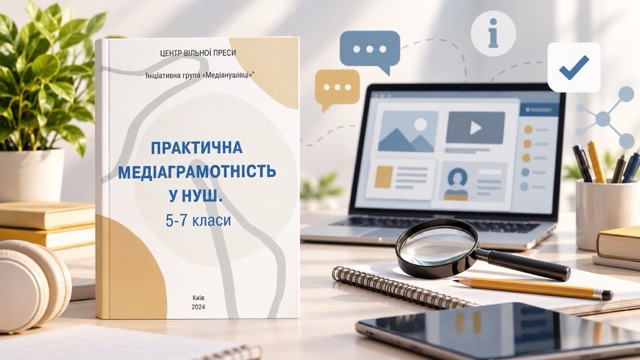
This is ‘Stereotype Busters’, from ‘Practical Media Literacy in the New Ukrainian School: Grades 5–7’. Designed for a Ukrainian language lesson revisiting antonyms, it takes up to thirty minutes.
First, briefly explain that a stereotype is a simplified idea about a person, group, event or phenomenon. Such shortcuts help us assess situations quickly, but often misrepresent reality and prevent us seeing an individual or a fact.
Divide the class into groups. Give each a pair of opposite concepts or images and two tasks:
- Name two or three stereotypes associated with the pair.
- Write a sentence or short story challenging one of them.
Groups present their results. Ask where an idea might have come from: personal experience, conversations with adults, films, advertising, news or social media.
An ordinary topic on antonyms becomes a discussion about media influence, prejudice and responsibility for our judgements.
Questions for reflection include:
- Which stereotype had I never questioned?
- Why can stereotypes be unfair?
- Do images and media messages affect our attitudes towards people?
- What needs checking before drawing a conclusion?
- How can this learning be used outside school?
The exercise also works remotely. Groups can use Zoom or Google Meet breakout rooms and record examples on Padlet or Miro. If group work is impossible, use flashcards with the whole class or individual tasks in a flipped-classroom model.
‘Stereotype Busters’ is one of twenty-one ready-made activities. Others address blogging, privacy, false information, manipulation, doomscrolling, free speech, historical sources and pseudoscientific messages.
A practical handbook for the new school year
The start of term poses a practical question: how can teachers discuss information threats while covering the curriculum?
AUP’s library offers the free teaching handbook ‘Practical Media Literacy in the New Ukrainian School: Grades 5–7’. Teachers and methodology specialists developed its exercises for practical lower-secondary teaching.
Activities suit ordinary lessons, blended teaching and distance learning. Each specifies the subject, grade, topic, duration, expected outcomes, equipment and steps.
How media literacy meets New Ukrainian School requirements
The New Ukrainian School develops information, communication and digital competences. Pupils should learn to find and process information, check sources, distinguish facts from judgements, recognise manipulation and act safely online.
This need not require a separate subject. Media texts can be integrated into existing curriculum topics.
In Ukrainian language, pupils examine stereotypes and persuasive language. In history, they compare sources and assess reliability. Science lessons distinguish scientific facts from pseudoscientific claims. Arts lessons explore photographs, music and visual imagery.
This is the organising principle of the Grades 5–7 handbook.
Language and literature exercises
Nine activities cover Ukrainian language, literature and foreign languages:
- ‘Stereotype Busters’;
- ‘Transforming Media Messages’;
- ‘I Am a Blogger’;
- ‘Safe Social Media: Public and Private Information’;
- ‘Instructions as a Media Text’;
- ‘The Double-Entry Journal’;
- ‘The Art of Decoding and Interpreting Visual Images’;
- an exercise identifying online manipulation;
- a session on doomscrolling and continual exposure to negative news.
Pupils work with texts, posts, photographs and other messages, learning to distinguish private and public information, explain positions and create content responsibly.
Media literacy in science lessons
The science section’s three exercises develop verification and source assessment.
In ‘The Earth Trembles: Searching for the Truth’, for example, pupils analyse reports of natural phenomena and decide which data to trust.
The activities provide material for discussing pseudoscience, questionable publications and videos children encounter on social media.
History, citizenship and source verification
The citizenship and history section contains six exercises:
- ‘Interviewing an Eyewitness’;
- ‘Yellow Ribbon: A Twenty-first-century Resistance Movement’;
- ‘Spot the Fake: Critical Thinking in History’;
- ‘Information and Media’;
- ‘Detective Agency: Following the Trail of Human Rights’;
- ‘A Financial Receipt as Evidence of Support for Ukraine’s Armed Forces’.
Pupils compare sources, formulate questions, seek evidence and discuss how information affects individual and collective decisions.
Art as a media text
Three further activities apply media literacy to music, visual art and urban space: ‘Musical Defence’, ‘Art Through Media Literacy’ and the interactive ‘Kharkiv’s Sports Facilities’ quest.
Pupils analyse cultural images, investigate their context and discuss how art communicates information and affects emotions.
Does the handbook suit distance learning?
The authors provide online versions of many tasks, so teachers need not redesign every session themselves.
During video lessons, breakout rooms support group work. Pupils can post answers on Miro or Padlet, in shared presentations or documents.
Some work can be completed independently and discussed in class or online. This also suits blended learning.
Developed by teachers and methodology specialists
The authors work with pupils and have tested the approaches in lessons. The handbook therefore contains complete session plans rather than general recommendations alone.
Each exercise specifies:
- links to the model curriculum;
- topic and purpose;
- subject and media education competences;
- duration;
- materials;
- sequence of work;
- expected outcomes;
- online and in-person options.
Appendices provide step-by-step guidance for creating media education exercises for the New Ukrainian School. Teachers can adapt the structure to another subject, age group or topic.
Using the handbook throughout the year
A large standalone media literacy course is unnecessary. Begin with an exercise matching the next curriculum topic.
For social media work, use blogging, privacy or manipulation activities. Historical events lend themselves to source verification and eyewitness interviews. In science, analyse a questionable scientific claim.
Plans can be shortened, supplemented with examples and adapted to a particular class.
Where to download it
‘Practical Media Literacy in the New Ukrainian School: Grades 5–7’ was published in 2024, edited by Oksana Volosheniuk, Halyna Dehtiarova and Roman Shalamov.
It has 181 pages. ISBN 978-617-7370-72-6.
The handbook was created with Goethe-Institut Ukraine and the NotaYenota initiative through ‘Meet the Teacher’, with financial support from the German Federal Foreign Office.
Read the description and download the handbook free from AUP.
Translation note: This is a literary translation into British English, produced and proofread using a language model. Read the Ukrainian original.