CONNECT-EU MEDIA LAB: explaining European integration clearly and practically to local audiences
Explaining European integration to a community means moving from ‘What is happening on Ukraine’s path to the EU?’ to ‘What does this change mean for people here, and how can we verify and explain it?’ Those questions turn an abstract foreign-policy subject into everyday community reporting.
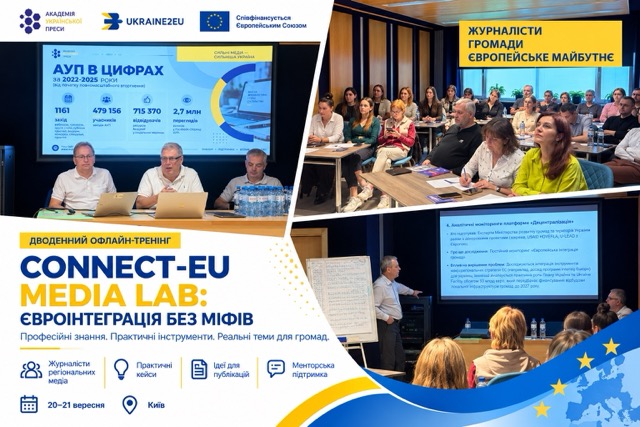
This was the focus of AUP’s two-day ‘CONNECT-EU MEDIA LAB: European Integration Without Myths’ training for regional journalists on 20–21 September 2026. Participants examined accession, associated reforms and community impacts through CONNECT-EU (Communities, News, Networks for European Union), supported by Ukraine2EU.
The main task was finding specific reporting ideas behind complex procedures, documents and political statements.
‘Two different working days, two different tasks, united by one goal,’ said trainer Oleksii Pohorielov, President of the Ukrainian Media Business Association and member of the Commission on Journalism Ethics.
He saw an important change in approach: participants moved from treating integration mainly as official news towards practical subjects affecting audiences, including community problems, employment, local business and opportunities.
He also noted differing readiness to move beyond familiar editorial practices. Much work therefore centred on ideas: potential topics, information sources and what readers should gain.
Day one examined accession and verification: screening, negotiating clusters and chapters, the Copenhagen criteria, European Commission reports and national plans.
Participants considered reforms locally, distinguishing commitments from declarations and explaining them simply without sacrificing accuracy. Practical cases involved checking claims and primary sources and finding stories about community services, business, education, mobility and product quality.
Day two focused on journalism: trust, balance, context, constructive reporting, expert competence and potential conflicts of interest.
The editorial laboratory concluded the programme. Journalists developed locally focused reform stories, identifying audiences, central questions, data, sources, expert contributors and community benefits.
‘Our newsroom writes extensively about European integration. Even so, I encountered new approaches, especially finding local angles and explaining complex processes through people’s needs. Discussing ideas with colleagues was useful too. The group supported some subjects I proposed. The next task is developing them into reporting interesting and useful to our audience,’ said participant Anatolii Zhupyna, Editor-in-Chief of Kherson’s Novyi Den newspaper.
The second trainer was Anatolii Shalaiev, local government expert, investigative journalist and moderator. He covered decentralisation, transparency, accountability, citizen participation and the use of documents, data and local cases.
‘European integration has concrete expression in laws, programmes, decisions and documents. It matters to discuss them, but in plain language. Politicians’ and diplomats’ language often hides important things behind generalities and slogans: easy to repeat, much harder to understand in practical terms for a community or individual,’ he said.
Participants left with publication plans, discussed and refined collectively. Work will continue with CONNECT-EU mentoring. Trainers said journalists left ‘with a vision of what can be done’.
‘European integration should not remain a subject only for state institutions, politicians or national media. It needs discussion where people see changes daily: in communities. Journalists should involve local experts, opinion leaders and residents and explain specifics rather than abstract European prospects or slogans. What changes? Which opportunities open for people and businesses? What has been done and what remains? Through a community’s actual needs and experience, integration becomes understandable,’ said AUP President Valeriy Ivanov.
About the organisers
AUP is one of Ukraine’s leading civil society organisations. For more than two decades, it has worked in journalism, media literacy and civic education, delivering large-scale projects nationwide.
Ukraine2EU is a flagship European Union initiative supporting Ukraine’s preparations for accession and future membership.
This post was prepared with financial support from the Ukraine2EU Programme. The views and opinions expressed are the sole responsibility of AUP and do not necessarily reflect the position of Ukraine2EU or the European Union.
Translation note: This is a literary translation into British English, produced and proofread using a language model. Read the Ukrainian original.