Media Detectives: The Case of the ‘Indian Trail’ – a media literacy exercise on information operations
The original media literacy exercise Media Detectives: The Case of the ‘Indian Trail’ examines an information operation through specific media examples. Participants analyse four pieces of ‘evidence’, distinguish fabricated stories from manipulation, misinformation and clickbait, trace original sources and consider the reaction each item was designed to provoke.
The exercise was developed by psychologists and trainers Iryna Tseba and Svitlana Vorontsova. They presented it at the FreeMind Ukraine trainers’ laboratory, where colleagues tested original teaching methods, discussed them and suggested adaptations for different audiences.
Media Detectives at a glance
- Authors: Iryna Tseba and Svitlana Vorontsova.
- Format: analysis of four real media items, structured as a detective investigation.
- Case topic: the disinformation narrative alleging ‘mass settlement of Ukraine by migrants from India’.
- Learning task: identify the information problem, check the context and understand why the message was circulated.
- Core skills: critical thinking, fact-checking, working with original sources, analysing photographs and videos, and sharing information responsibly.
About the FreeMind Ukraine trainers’ laboratory
The project Filter Information – Create Change: A Trainers’ Laboratory. A Hackathon of Practices combined training with professional exchange among Ukrainian media literacy trainers. Participants ran their own exercises, tested them in practice and jointly considered what needed to change for particular audiences.
Media expert, Doctor of Pedagogical Sciences and Professor Tetiana Ivanova edited the exercise. She also moderated its trial with teachers and the professional discussion afterwards.
The series comprised five two-day online training courses attended by 109 media literacy trainers. Read more about the programme and its results in 109 media literacy trainers: AUP completes its online training-for-trainers series.
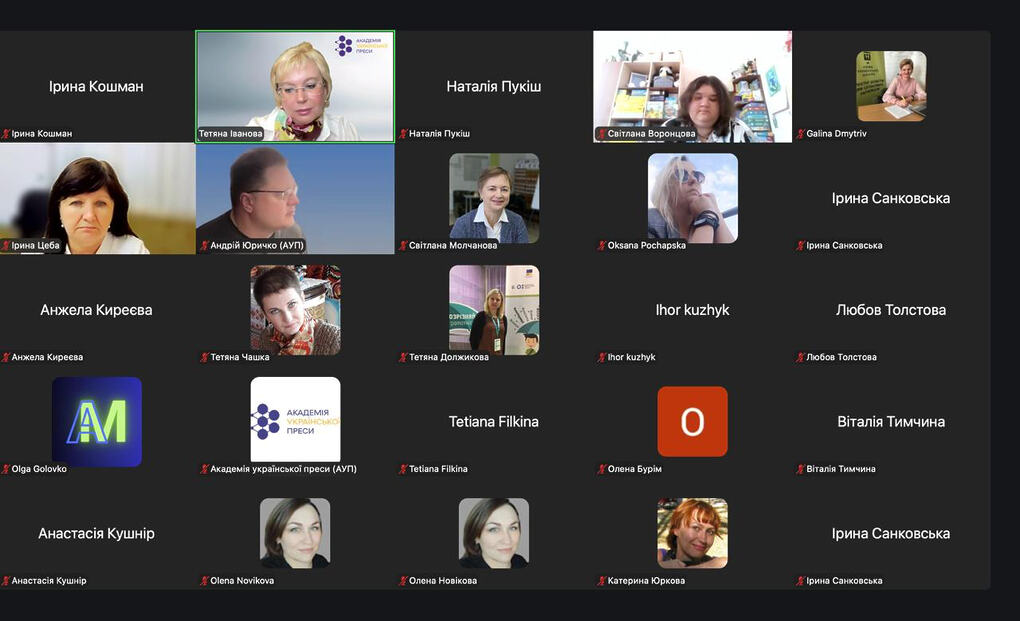
Participants in the FreeMind Ukraine trainers’ laboratory during the online trial of Media Detectives.
Who developed the exercise?
Iryna Tseba is a psychologist and media trainer at the Centre for Teachers’ Professional Development, a municipal institution of Karlivka City Council in Poltava Oblast. She sums up her approach as: ‘Teach the teacher – protect the pupil.’
Svitlana Vorontsova is a psychologist, media trainer and consultant at the municipal Karlivka Inclusive Resource Centre. She is also a UNESCO consultant on mental health and psychosocial support, an expert in a community of contemporary teachers and psychologists, and a psychologist with the PORUCH project.
Their work in media literacy began in 2017, after they attended the Academy of Ukrainian Press’s Summer School on Media Literacy. Between 2018 and 2026, the trainers delivered more than 50 training sessions, workshops and intellectual games for different audiences.
Photo 1. Iryna Tseba during a media literacy training session in AUP’s project with DW Akademie.
Photo 2. Iryna Tseba at a media literacy conference in AUP’s project with DW Akademie.
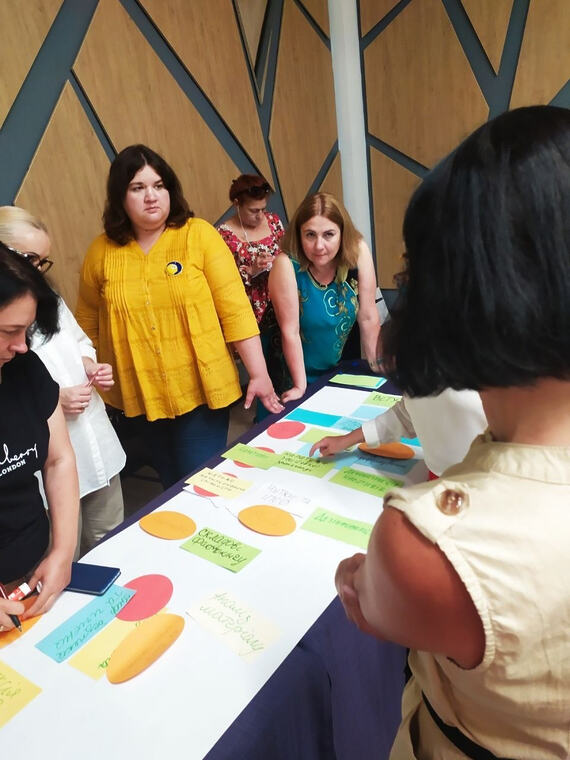
Photo 3. Svitlana Vorontsova during a media literacy training session in AUP’s project with Freie Universität Berlin.
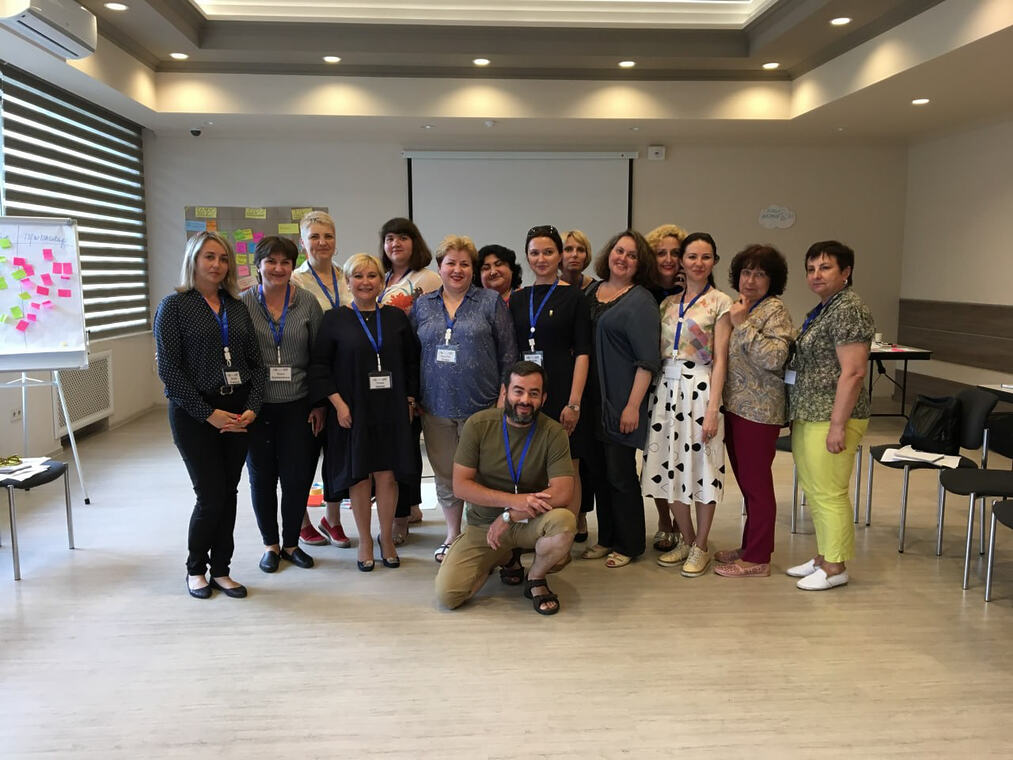
Photo 4. Svitlana Vorontsova during a media literacy training session in AUP’s project with DW Akademie.
What do participants investigate?
The exercise centres on messages alleging the ‘mass settlement of Ukraine by migrants from India’. Alarmist posts, videos, images and emotional headlines emerge around this claim. Each appears to offer a separate piece of evidence, although the material may be fabricated, taken out of context or accompanied by a manipulative explanation.
These messages exploit fears of external threats, loss of control and population ‘replacement’. The exercise shows how a single invented topic can be used to set groups against one another and create a sense of danger to Ukrainian society and national identity.
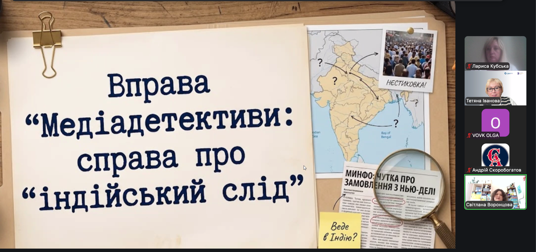
Media Detectives: The Case of the ‘Indian Trail’.
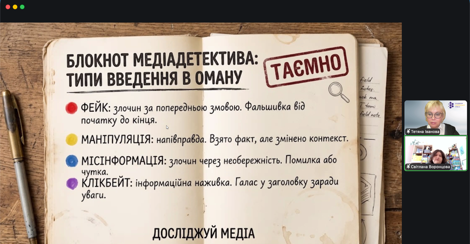
The media detective’s notebook: fabricated stories, manipulation, misinformation and clickbait.
How the media investigation works
‘Fellow detectives, welcome to our information detective agency!’
The session opens with this greeting. Participants receive four pieces of ‘evidence’: real media items to investigate and classify. They must identify a fabricated story, manipulation, misinformation and clickbait among them.
Naming the category is not enough. Every conclusion needs supporting reasons. Participants therefore ask:
- What exactly makes this material seem believable?
- Which emotion is it designed to trigger?
- What information is missing from a full understanding of the situation?
- What has been changed or taken out of context?
- Who published the material first?
- Do independent sources corroborate what we see?
This takes participants from memorising terms to checking information systematically.
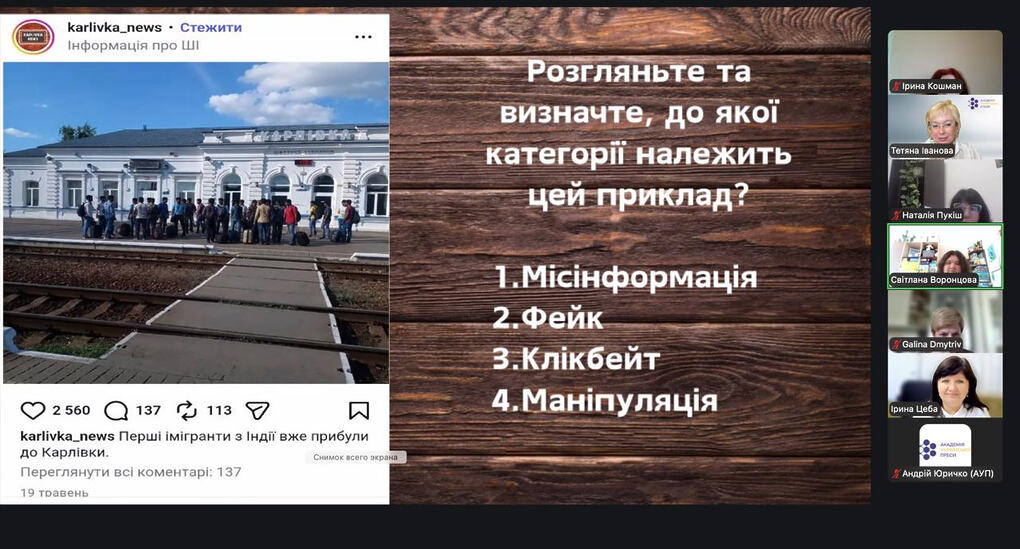
Example 1. A post about passengers from India: participants identify the type of information problem.
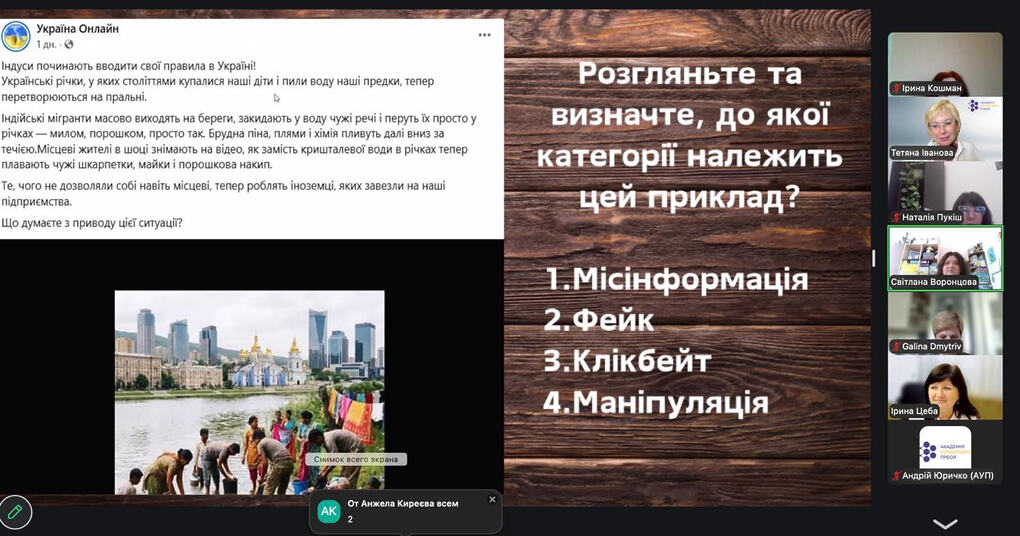
Example 2. An AI-generated image used as purported evidence of an invented story.
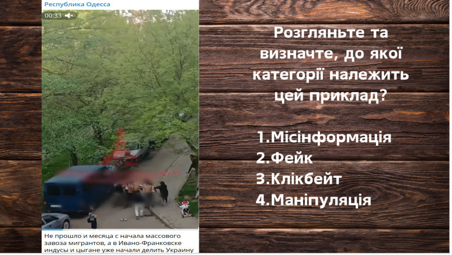
Example 3. A video taken out of context and presented with a different explanation.
A video stripped of context and an AI-generated image
One item uses footage of a fight originally published by a local Telegram channel. A subsequent post partly concealed the original source’s name and supplied a different explanation. The initial post concerned another situation; the people’s nationalities cannot be established from the video alone.
This demonstrates a common technique: someone manipulating information need not invent an event. They can take genuine footage, remove its context and add the interpretation they want.
Another piece of ‘evidence’ is an entirely fabricated photographic fake. An AI-generated image combines features of Kyiv with people wearing traditional Indian clothing. Its purpose is to provide visual support for a story that has no factual evidence.
Verification therefore means asking not just ‘Is there a photograph?’ but ‘Does this photograph prove what the message claims?’
Which skills does the exercise develop?
Participants learn to interrupt an automatic reaction to emotional material and examine how a message is constructed. They distinguish an invented story, a real fact given a manipulative explanation, incorrect information and a headline designed to attract attention.
A separate stage focuses on original sources. A screenshot, a short video clip or another user’s account does not provide the whole picture. Participants need to find the first publication, compare versions and establish where the material came from.
The exercise also develops visual literacy. Generative AI can produce convincing pseudo-evidence, so photographs and videos require the same scrutiny as written claims.
From a single false story to an information operation
The exercise’s central question is: ‘Why am I being shown this?’ It moves the investigation from an individual message to the wider narrative.
The exercise description explains that the campaign alleging mass resettlement of Indians was intended to spread panic, demoralise audiences and invent internal threats. It does not require one large fabricated story. A narrative can be sustained by many small pieces of apparent ‘corroboration’: photographs, videos, rumours, comments and emotional headlines.
An individual message can be debunked. Yet someone who has already accepted the broader story may see subsequent material as confirmation of their views. Training therefore needs to explore the relationship between individual posts and the purpose of the whole information campaign.
The closing exercise: Devil’s Advocate
After analysing the cases, the authors introduce tools for checking information.
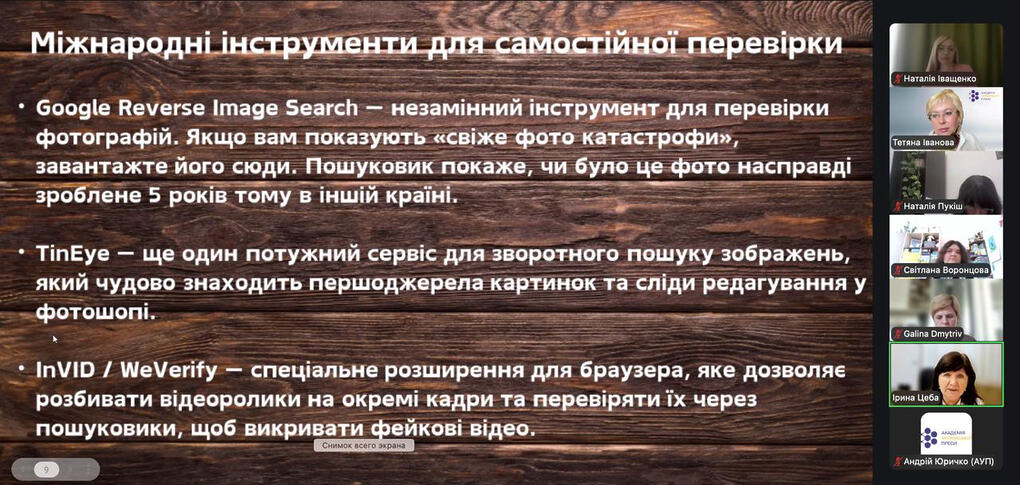
Google Reverse Image Search, TinEye and InVID/WeVerify: tools for independently checking images and videos.
The session ends with Devil’s Advocate. Participants are asked to respond to an acquaintance who says:
‘I believe everything in the news. I don’t have time to check facts; it doesn’t kill anyone.’
Their response should draw on the investigation’s findings. This discussion moves beyond terminology to personal responsibility. Disinformation spreads through its creators’ actions, but also through the habit of sharing messages without checking them.
How to use the exercise in teaching
A Media Detectives session can follow this sequence:
- Present four media items as pieces of ‘evidence’.
- Ask participants to classify each item and explain their choice.
- Check original sources, context, visual details and independent corroboration.
- Identify the shared topic and possible purpose of the information campaign.
- Discuss personal responsibility for sharing unverified messages.
This sequence helps participants recognise the method of influence behind a single publication and the information operation behind a series of related items.
Other FreeMind Ukraine exercises and resources
AUP’s series also includes Svitlana Bohdziievych’s Information Bubble, about social media algorithms, and Halyna Dehtiarova’s A Place for the Dragon, about how media construct images and explain reality.
Training news, practical exercises, handbooks, case studies and presentations are collected on the FreeMind Ukraine project page.
FreeMind Ukraine: Young People and Communities Against Manipulation is implemented by the Academy of Ukrainian Press in partnership with the Centre for Media and Information Literacy (CeMIL) at the Institute for Media and Communication Studies, Freie Universität Berlin.
Translation note: This is a literary translation into British English, produced and proofread using a language model. Read the Ukrainian original.