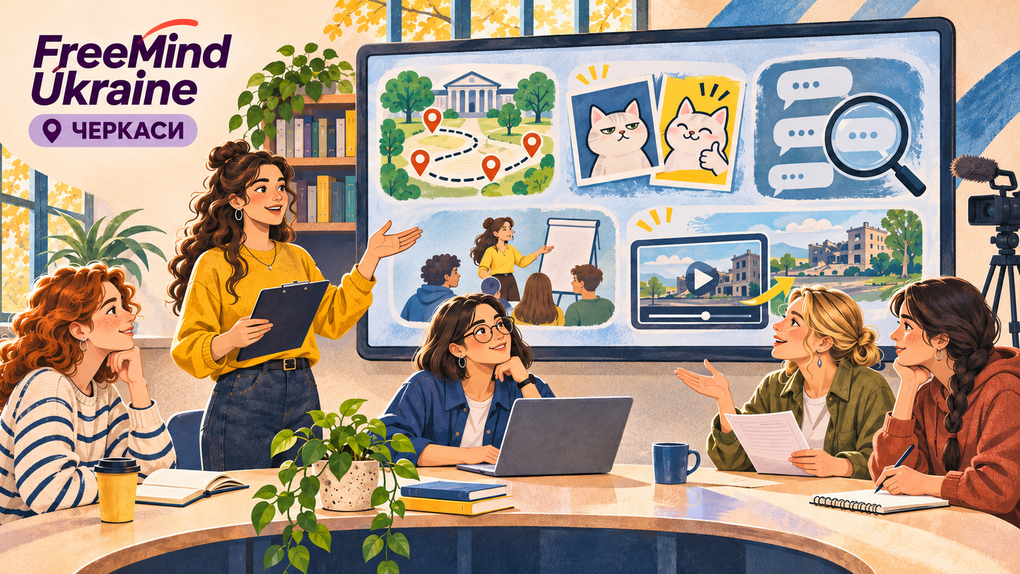
FreeMind Ukraine in Cherkasy: from memes to a media quest
Illustration created using AI.
Cherkasy National University students present media literacy projects
A university library and television studio became media-quest stations, while training participants searched for manipulation in a purpose-built Telegram channel. Teams at Bohdan Khmelnytsky National University of Cherkasy created educational memes, filmed videos about missing context and taught schoolchildren. On 3 November 2026, they presented the work to AUP, representatives of Ukraine’s Ministry of Education and Science and university lecturers.
The online round table opened the presentation stage for FreeMind Ukraine’s student initiatives. Twenty Cherkasy students worked in five teams. Each implemented its idea and explained what worked, what changed and how audiences responded.
‘FreeMind Ukraine: Youth and Communities Against Manipulation’ is a joint project of the Academy of Ukrainian Press and Freie Universität Berlin. AUP organises training and supports participants in preparing initiatives. Afterwards, students develop resources and hold university events, introducing media literacy to new audiences.
AUP President Professor Valeriy Ivanov, Doctor of Philology, opened the meeting, welcomed the teams and recalled the project partners:
‘Welcome as participants in our media literacy and critical-thinking project. We run it with Freie Universität Berlin, our longstanding partner, funded by the German Federal Foreign Office. As I understand it, the student projects have already been implemented, and we will now take a brief look at how they work.’
AUP Project Coordinator Yuliia Kulyk suggested focusing on students’ own experience:
‘Over recent months, we delivered five two-day training courses in different Ukrainian cities, covering manipulation, critical thinking, fact-checking and digital security. Most importantly, students began developing initiatives of their own. Today, we particularly want to see what became of those training ideas. What was implemented, what difficulties did teams face, what solutions did they find and what results did they achieve? We therefore want to listen more to the students.’
AUP Media Education Programme Manager Maksym Zaporozhchenko also moderated. He discussed cooperation with the Ministry of Education and Science:
‘In 2024, we signed a five-year cooperation memorandum with the Ministry. It recognises our long history of working together. Alongside journalists’ professional development, AUP runs media literacy initiatives. Today brings journalism and media literacy together.’
Roman Hladkovskyi, Chief Specialist at the Ministry’s School Education Directorate, attended. He stressed that education should teach young people:
‘To use information, share it, filter it and, above all, protect their own interests and those of our state, Ukraine.’
The teams then presented their projects. Organisers asked follow-up questions and discussed results and prospects for continuing.
‘Don’t Fall for It’: four media-quest stations for first-year students
The media-quest team invited first-year students from different university institutes to follow a route of media literacy tasks. Announcements circulated through student chats, councils and hall-of-residence groups; participants registered online.
Participants formed four teams. Each received a map and independently located the university library, media literacy classroom, departmental television studio and Cherkasy Mediabase. They completed tasks and earned points, finishing with a shared final challenge and recognition for the teams.
The quest combined information skills with an introduction to university and media spaces. The organisers wanted students from different subjects involved: everyone using social media needs to verify news and recognise manipulation.
‘We wanted to show that media literacy is not just theory but an important everyday skill. Our experience showed that quests can effectively engage students with important social issues. The initiative could expand, involve new partners and be adapted for other student communities.’
The team also described organisational difficulties. Attendance differed from expectations, requiring quick adjustments to team arrangements. Departmental lecturers helped. The students particularly thanked Mediabase for providing a location and offering support.
The team said participants expressed interest in similar events. The organisers are considering repeating the quest, extending partnerships and inviting other student communities.
‘Media Memes’: brief explanations in a familiar format
The Media Memes team addressed the habit of responding instantly to content – liking, forwarding or commenting before checking.
The students created two collections of memes with short explanations of manipulation and information consumption. They chose recognisable images to attract students’ and lecturers’ attention on social media.
Combining image and explanation proved hardest. The meme needed to remain understandable and memorable when users encountered similar situations in their feeds.
Team leader Yuliia said:
‘It was difficult to work out how to combine a meme and caption so it felt relevant to life, rather than something you read, close and forget. I would really like to keep creating these memes because it is fun and interesting. I enjoyed doing it, and so did the other students.’
Material was published through the Media Literacy Centre and university channels. The authors collected statistics and comments and said they wanted to continue. Discussion also covered involving new students and eventually handing the initiative over to them.
‘Error 404’: checking anonymous Telegram channels
Posts in anonymous Telegram channels prompted this initiative: exaggeration, unverified claims, subjective judgements and sensational headlines.
The team prepared training and an educational Telegram channel containing posts for analysis. Some met journalistic standards; others used manipulative techniques. Participants identified problematic material, verified information and explained their conclusions in comments.
A separate discussion examined when anonymity might be justified and the risks when readers do not know who is responsible for content. Handouts provided examples of manipulation and ways to recognise it.
An air-raid alert interrupted the classroom training, which continued online another day. According to feedback shared by the team, participants particularly liked the practical section.
Team member Diana said:
‘We planned to delete the Telegram channel afterwards because we did not think we needed to keep it. But students said it contained useful information. They asked us to leave it so they could see and remember what different forms of manipulation look like.’
‘Media Literacy School’: sessions for first-year students and young reporters
The Media Literacy School team delivered two training sessions for first-year students and members of the YuniKo children’s television studio. Topics included AI, fact-checking, propaganda and the danger of young people being recruited.
Participants analysed false and manipulative messages, discussed signs of propaganda and jointly formulated AI prompts. The students offered practical tasks and invited audiences to share experiences.
Working with younger participants required additional preparation. At the round table, the team stressed the responsibility involved in choosing sources and checking explanations others would hear.
The second session took place in a shelter, with some participants joining online. The team completed the programme, collected feedback and awarded certificates. They hope to return to the children’s group in spring with new topics and exercises informed by that feedback.
Team leader Viktoriia said:
‘I am pleased with the audience’s engagement and how productively we worked together. In the final survey, we asked what needed improvement and will certainly take that into account. We think the project could continue in spring.’
‘Context Changes Everything’: three videos and over 6,000 views
This team explored how perceptions change when context is removed. Educational videos used photographs, quotations and video excerpts that had been given misleading interpretations in the media.
The students explained finding original sources, checking circumstances and distinguishing facts from others’ judgements. Interactive elements let viewers test their understanding.
During production, the team reconsidered its examples. One planned story was withheld because the authors doubted whether audiences would understand the main point or become distracted by a side issue. Three videos were ultimately published.
Team leader Daria Demkovych said:
‘Our project showed that understanding events requires seeing the full picture, not just an isolated fragment. We also stressed checking primary sources, finding the complete context, comparing different sources and separating facts from other people’s judgements. We stated this at the end of every video.’
At the time of presentation, the team reported over 6,000 combined views and more than 200 likes. The videos appeared on the Media Literacy Centre’s and department’s pages and remain available to watch and use in teaching.
What the teams discussed afterwards
Yuliia Kulyk invited teams to explain the hardest parts and how implementation differed from their original ideas.
Participants discussed finding safe rooms, rescheduling sessions, unstable internet and engaging audiences. One team urgently changed format because a room was occupied during an alert. Others described dividing responsibilities, collaborating remotely and asking lecturers for help.
Roman Hladkovskyi particularly noted Media Memes and the media quest, appreciating familiar visual formats and game-based learning. His overall assessment was:
‘In my view, all the projects are quite substantial. There are a few small issues with presentation, but they are minor considering what students were supposed to achieve through learning and participating. The training provided by AUP and lecturers’ help in studying topics and developing projects are very important. I think every team completed the task successfully.’
Tetiana Bondarenko, Head of the Department of Journalism, Advertising and PR Technologies, and lecturer Olena Pohribna supported preparation, event organisation and audience work. Resources were shared through the Media Literacy Centre, department and university channels.
Tetiana Bondarenko recalled several years of university cooperation with AUP, including the Media Literacy Centre and an elective for students of different subjects. She praised the teams’ independence:
‘The alert sounds, there is no electricity or internet, but we keep working. I am grateful to AUP for opportunities that inspired further projects rather than simply ending. I really liked students’ project work. Working as teams was very productive, in my view. They independently completed every stage: idea, development, implementation and publicity.’
Olena Pohribna described watching students prepare sessions and learn the trainer’s role:
‘I am very pleased for our students. They tried to implement their projects as effectively as possible, worried about them and prepared thoroughly. It was interesting to see them become teachers and trainers. Every project required working with another audience, whether younger or their own age. It was fascinating to watch them take on that mentoring role, worry and organise.’
All five teams implemented their projects successfully. A competitive selection will determine which teams can join a study visit to Berlin.
Some have already identified next steps: more memes, another quest and new school sessions. Published videos and the educational Telegram channel remain available after the presentations.
The Academy of Ukrainian Press implements FreeMind Ukraine with Freie Universität Berlin, funded by the German Federal Foreign Office.
Read about the preceding training in Cherkasy, Lutsk and Poltava, and how Lutsk National Technical University students presented a media quest and AI podcast.
The article on student project presentations in Poltava will be available on 6 November at 10:00.
The FreeMind Ukraine platform collects all news, learning resources and further information for participants and anyone interested in media literacy.
Translation note: This is a literary translation into British English, produced and proofread using a language model. Read the Ukrainian original.