FreeMind Ukraine in Poltava: an interactive AI game and university news on TikTok
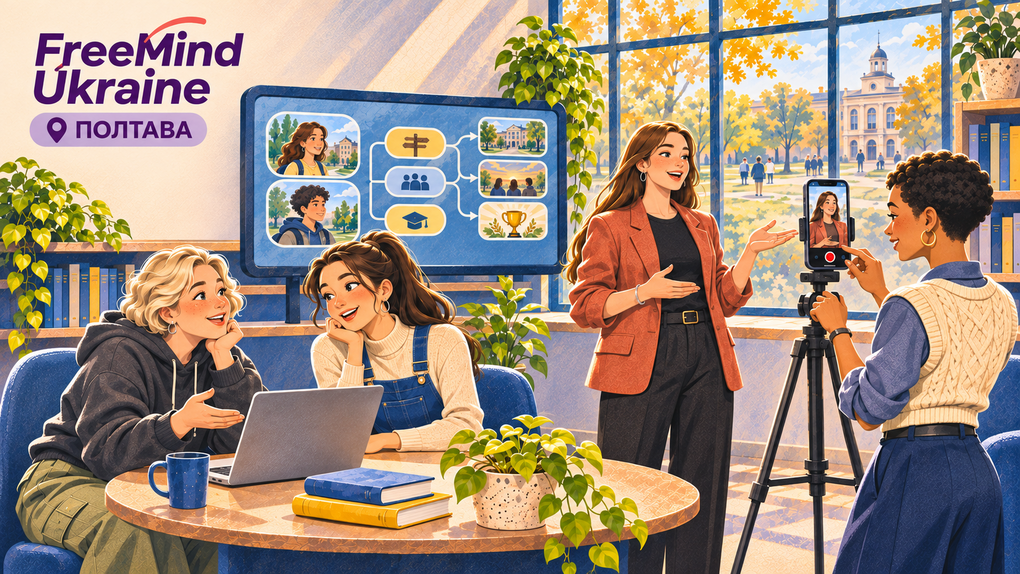
Illustration created using AI.
Poltava V. G. Korolenko National Pedagogical University students present their media literacy projects
In a web game, students chose how to use artificial intelligence in their studies and immediately saw the consequences of their decisions. Another team launched a TikTok studio covering university events, which is already receiving suggestions from lecturers and the admissions committee. Both initiatives were presented on 5 November 2026 at FreeMind Ukraine’s third online round table.
Participants presented their work, shared audience feedback and explained how they had implemented the projects. With the Academy of Ukrainian Press team, representatives of Ukraine’s Ministry of Education and Science and university lecturers, they discussed continuing the work and involving more students.
The Academy of Ukrainian Press and Freie Universität Berlin run ‘FreeMind Ukraine: Youth and Communities Against Manipulation’. AUP trains and advises student teams developing their own initiatives. In Poltava, the work began with a two-day training on 15–16 September 2026, when participants analysed manipulation and planned projects.
Read about the initial training in Poltava, Lutsk and Cherkasy.
AUP President Professor Valeriy Ivanov, Doctor of Philology, opened the meeting. Welcoming the teams, he emphasised the experience gained through independent work:
‘When students create their own project, they put what they have learnt to the test. They must choose a topic, understand their audience, prepare material and see how people respond. This brings responsibility for every message and experience of working with feedback. It matters to us that, after the training, students can run sessions and create media material for others independently.’
AUP Project Coordinator Yuliia Kulyk moderated the discussion. She recalled that AUP had delivered five training courses involving five universities across Ukraine, then helped students prepare content and plan their events.
‘We encourage them to implement their own projects independently, develop, analyse and take a critical approach to any information. Through them, we also try to encourage other students and young people to approach what they hear or see on social media critically.’
AUP Media Education Programme Manager Maksym Zaporozhchenko discussed the teams’ work with audiences:
‘In the web game, participants choose how to use AI and see the consequences of their decisions. The TikTok studio team tackles a different practical task: getting university news to students. Both projects let students work with real audiences and change their material to meet their needs. That experience should inform the teams’ next sessions and publications.’
Professor Svitlana Semenko, Head of the university’s Journalism Department and Candidate of Philological Sciences, thanked AUP for training, consultations and teaching resources. Lecturers and students use the Academy’s textbooks, handbooks and exercise collections, and apply their training experience in their work, she said:
‘We are learning from AUP how to deliver training ourselves for our students and communities. We work extensively with communities and hope to involve students in that work. It is much needed now.’
Roman Hladkovskyi, Chief Specialist at the Ministry of Education and Science’s School Education Directorate, also attended. After the presentations, he praised both projects and discussed Korolenko Studio’s results:
‘I really liked both presentations: they were of a high standard and concisely delivered. I particularly want to highlight Korolenko Studio, which has already demonstrated practical implementation and engagement with the university administration. TikTok has become a channel for distributing information, involving students and promoting the institution. It is encouraging that the project already has results and can improve further: the presentation is over, but the channel keeps working. In my view, other educational institutions in Ukraine should use this experience to reach audiences who might later join a university as students or teachers.’
‘Write me an AI masterpiece’: using AI and taking responsibility for your work
Journalism students presented ‘Write me an AI masterpiece’, also called ‘How I Use Artificial Intelligence’. Third-year student Anna Andriiko led the team and facilitated the interactive sessions. Second-year student Kateryna Chernova prepared the theoretical material and developed the web game.
Second-year student Kseniia Hryhorenko handled presentation design and technical work. Third-year student Yelyzaveta Kryvoruchko photographed the events and prepared the final survey.
The authors wanted to discuss students’ habit of delegating entire assignments to AI. The sessions explained how to use it as an assistant, check answers and uphold academic integrity.
The theoretical section covered AI models for learning, prompts, tokens and the reasons for fabricated answers. Participants entered different prompts into their usual tools and compared the results.
Kateryna Chernova said explanations sometimes needed adjusting during sessions. For example, a detailed prompt and a shorter one with the same meaning sometimes produced similar answers. The team realised it needed to test examples in different models and choose them according to the audience’s needs.
The students acted on feedback during the lectures. Participants wanted more practice, so the authors added tasks allowing them to try the tools themselves.
For the interactive section, cards were used to pair students. Each received part of a sentence and had to find the person holding its continuation. The pairs then moved to the web game, featuring fictional characters Vasyl and Taisiia.
The characters faced study-related situations, and participants chose one of three actions: use AI, do the task themselves or combine the two approaches. Their choices changed the course of the story. The audience discussed the consequences together.
Kateryna Chernova built the game using AI. Its development was itself an example of AI use, while the storyline opened a discussion about responsibility for one’s decisions.
Anna Andriiko said the interactive section had been particularly successful in engaging participants:
‘I think we certainly succeeded with the interactive component, because the students were genuinely engaged, and their feedback shows that this was what they enjoyed most.’
The team delivered three interactive lectures for groups in the Faculty of Ukrainian Philology and Journalism and has already been invited to other faculties. For future sessions, the students intend to adapt examples to different subjects: prompts useful to journalists do not always meet the learning needs of philologists or future teachers.
Korolenko Studio: university news in the TikTok feed
Team member Yaroslava Hryhorieva presented the second project. The team created the ‘Korolenko Studio. PNPU News’ TikTok account to tell students about university life in a familiar format.
The authors noticed that information on the university website did not always reach people who might find it useful. Students could miss an exhibition announcement, meeting or other event unless they deliberately looked for such notices.
The team began selecting news and turning it into short videos and information round-ups. The page publishes event announcements and covers university activities and student achievements. Round-table participants viewed the account and examples of its work.
Yaroslava Hryhorieva said the team began receiving questions about announced events in its first month:
‘People even asked us when and where particular events would take place.’
From student news to material for prospective applicants
The initiative attracted attention within the university. Svitlana Semenko said the head of the admissions committee had approached her after seeing the TikTok page and suggested material about preparatory courses.
The team thus began working for prospective applicants getting to know the university and deciding where to study. The students also described support from university social media pages and approaches from lecturers suggesting events to cover.
The studio plans to work with other faculties so the account represents the whole university. Yuliia Kulyk suggested involving their students in filming and publishing the material on the shared page.
The two projects have already intersected: Korolenko Studio is preparing material about the sessions delivered by Anna Andriiko and her colleagues.
Teams in Cherkasy and Lutsk presented their work earlier.
The Academy of Ukrainian Press implements FreeMind Ukraine with Freie Universität Berlin, funded by the German Federal Foreign Office.
The FreeMind Ukraine platform collects all project news, learning resources and additional information for participants and anyone interested in media literacy.
Translation note: This is a literary translation into British English, produced and proofread using a language model. Read the Ukrainian original.