FreeMind Ukraine in Zhytomyr: a Telegram meme game and a media quest for first-year students
Illustration created using AI.
Zhytomyr Ivan Franko State University students present their media literacy projects
Spot manipulation in a headline, distinguish a real photograph from a generated image, and receive an explanation accompanied by a meme. That is how ‘Not Necessarily a Fact’, a Telegram game created by students in Zhytomyr, works. Another team has prepared a university media quest: first-year students will follow a route with tasks and deliberately misleading clues before receiving their student identity cards.
The teams presented their work on 10 November 2026 at FreeMind Ukraine’s fourth online round table. With the Academy of Ukrainian Press team, representatives of Ukraine’s Ministry of Education and Science and a university lecturer, they discussed the tasks, early user feedback and difficulties affecting planned events.
The Academy of Ukrainian Press and Freie Universität Berlin run ‘FreeMind Ukraine: Youth and Communities Against Manipulation’. AUP trains and advises student teams developing media education initiatives. In Zhytomyr, the work began with a two-day training on 29–30 September 2026. Participants then chose topics, identified audiences and started preparing projects.
AUP President Professor Valeriy Ivanov, Doctor of Philology, opened the meeting, welcomed participants and invited the teams to present their independent work.
‘What particularly interested me in the Zhytomyr projects was how students work with a specific target audience. The Telegram game team considered where their peers read news, how much time they would spend learning and what would hold their attention. The media quest’s authors combined verification with first-year students’ introduction to university. Such choices require independently selecting examples, testing tasks and being willing to revise something after the first attempt. For AUP, another outcome of training is that students take on this work and create resources others can use.’
Roman Hladkovskyi, Chief Specialist at the Ministry’s School Education Directorate, also attended. In his welcome, he noted AUP’s work with different educational audiences and the need to analyse information critically during wartime. Assessing the projects, he discussed game-based learning and quests:
‘These projects carefully consider what participants should do: analyse a headline, explain an answer, check a clue or find the next location as a team. The Telegram game lets users return immediately to a mistake and examine the explanation; the prepared media quest offers critical-thinking practice along a shared route. I welcome the use of examples familiar to students, which makes it easier to connect tasks with everyday information. Quests enable active participation: people must discuss, compare and make their own decisions. After the in-person quest, it will be useful to collect first-year students’ feedback and establish which tasks helped them recognise manipulation and verify information.’
AUP Project Coordinator Yuliia Kulyk moderated the discussion. Teams explained their chosen problems, division of responsibilities, what they had tested and what needed further work.
‘At the round table, we asked teams to show exactly how someone would use their project. In the Telegram game, we can follow the entire process: receiving a task, answering and reading an explanation. For the media quest, the students planned the route, staffing at locations and a way to check whether a team had completed every stage. We value participants discussing difficulties too: technical improvements, distance learning and in-person events’ dependence on security conditions. That allows a specific discussion of next steps and the support each team needs.’
Andrii Blyzniuk, Candidate of Philological Sciences and Associate Professor in the university’s Department of Journalism, Advertising and PR, supported the students. He explained that distance learning, heating problems in university buildings and delayed arrival of student cards had prevented all planned events from taking place.
‘The students have already done substantial independent work: prepared tasks, devised the game mechanics and organised the quest. The Telegram bot enables remote participation, and the team has received initial feedback. The university quest requires first-year students to be physically present, so it depends on returning to in-person teaching. We have management support and student interest and expect to hold the prepared event as soon as conditions allow. I am pleased to see participants ready to explain decisions, answer questions and continue despite delays.’
‘Not Necessarily a Fact’: media literacy on Telegram
Team member Mariia presented the first project. With Liza, Oleksandra and Alina, she developed the ‘Not Necessarily a Fact’ Telegram bot to practise media literacy.
The idea arose during AUP’s training. Students discussed recognising increasingly convincing AI content, spotting manipulative headlines and analysing social media comments. They also sought exercises in which users could apply media literacy knowledge themselves.
The first audience was students and staff in the Department of Journalism, Advertising and PR. The team chose Telegram after discussing training participants’ information habits: many regularly read news there. They kept tasks short and added memes to hold attention.
Tasks with explanations and familiar examples
According to the presentation, the game contains 31 tasks of twelve types. Users identify a manipulative word, select a neutral headline, distinguish fact from opinion, analyse an image or assess whether a person or bot might have written a comment.
After answering, participants receive an explanation. For example, an AI-image task highlights blurred lettering and other details worth examining.
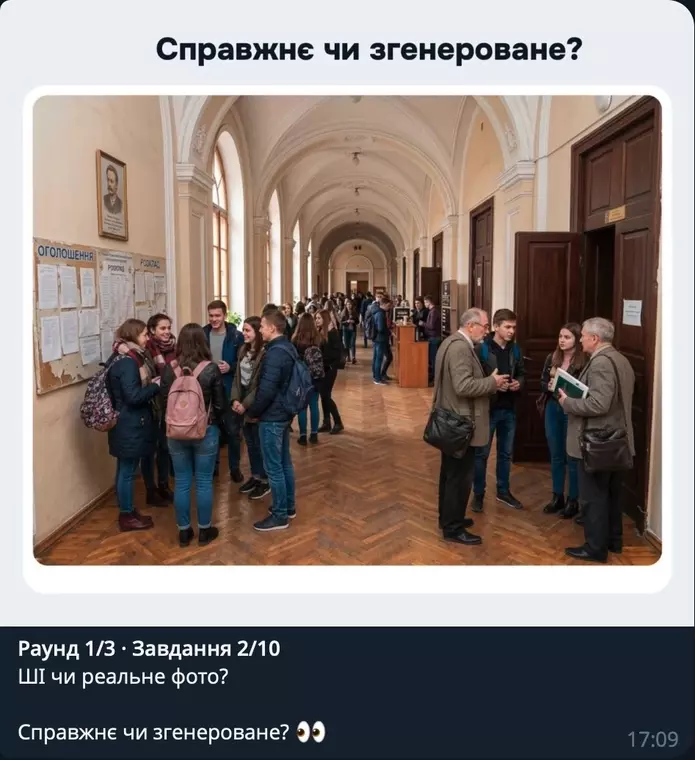
Your answer: 📷 Real
❌ Not quite.💡 Look closely at the noticeboard: the text is gibberish and the caption beneath the portrait is unreadable. Illegible lettering is a common sign of AI 🔍
Explanation accompanying the university-corridor image task. Material from the ‘Not Necessarily a Fact’ Telegram bot.
In a headline exercise, the bot explains how one person’s statement can be turned into a supposedly shared position of unnamed ‘experts’. The learning card describes a fictional event and two ways of reporting it.
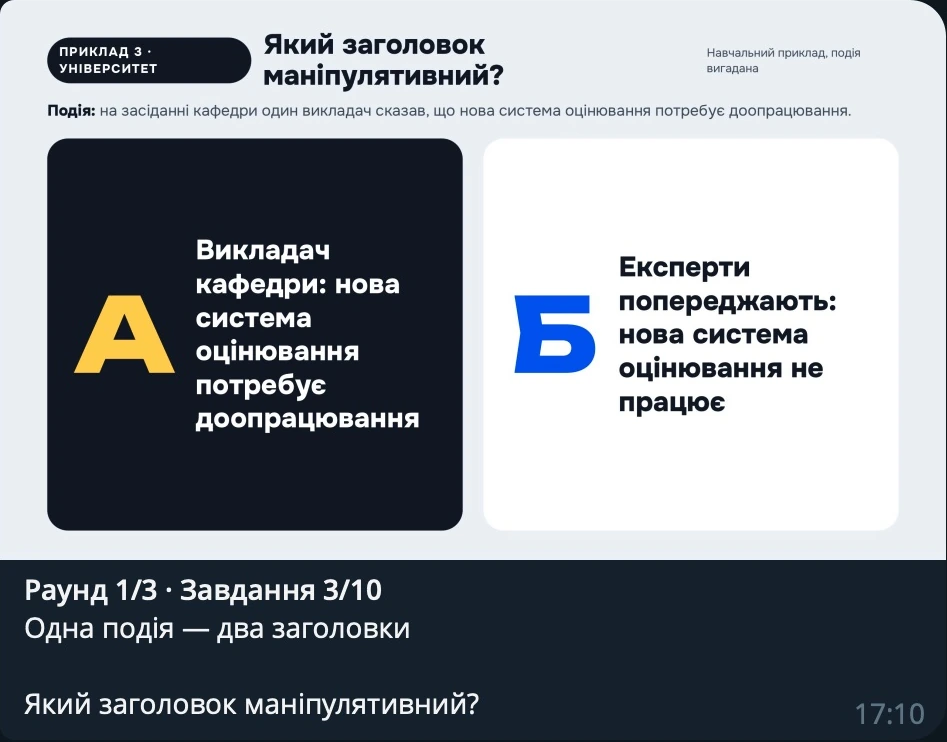
One event, two headlines: participants must identify manipulation. The event in this learning example is fictional.
The students used local examples connected with Zhytomyr and the university. Familiar places and situations were intended to encourage closer attention. The game is also intended for users outside the university.
As Mariia explained:
‘We simply used local examples so people would pay more attention. The tasks themselves, though, are aimed at developing media literacy skills.’
First users and feedback
The authors first approached relatives and friends to identify difficulties and what needed further work.
By the round table, the bot was publicly available. After testing and technical improvements, the team shared it with friends and fellow students. In the first week, 26 people started the bot.
Users began sending feedback without being specifically asked at the end of the game. The students said users mentioned the memes. A ranking lets players compare results. The authors plan to promote the game more widely within the university.
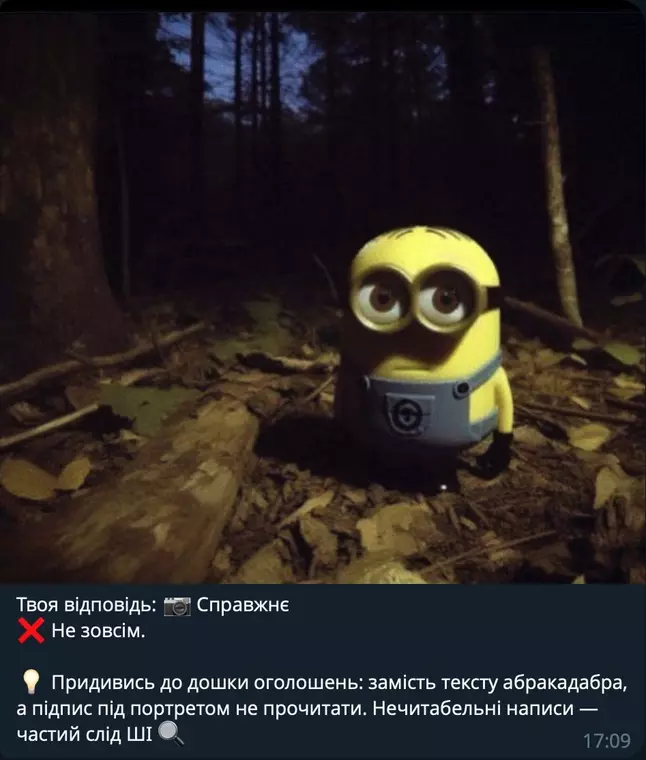
Round 1/3 · Task 2/10
AI or a real photograph?Real or generated? 👀
‘Real or generated?’: a question accompanying an image of a Minion. Material from the ‘Not Necessarily a Fact’ Telegram bot.
All four students worked on examples. They divided topics, collected and discussed material, and turned it into tasks. Oleksandra said:
‘At times it was difficult: no electricity, then no water, then something else. But we achieved this result, and I am proud of it.’
Try the game on Telegram: ‘Not Necessarily a Fact’, @nefakt_zdu_bot.
A media quest for first-year students: check clues and find your route
Taisiia presented the second project, prepared with Yeva, Anastasiia, Madina and Nadiia. It combines an introduction to university with critical-thinking tasks.
The team plans to invite first-year students studying Polish and Ukrainian languages, journalism and publishing. They will form two teams and follow a route through university buildings.
Taisiia explained:
‘The main aim is to make first-year students’ introduction to university more interesting and interactive. Through the quest, they can learn their way around the buildings, meet students from other subjects, make friends and learn teamwork.’
A map that should not be trusted without checking
The team has prepared two route maps, each marking six points, one deliberately misleading. The complete route is intended to cover seven locations, which participants will not initially know.
At each stop, students will tackle tasks involving media literacy, languages, journalism and publishing. Other students will staff individual locations and help teams progress.
The deliberately inaccurate map is intended to prompt verification and comparison of clues. At one such stop, a student will offer an additional task whose answer helps identify the next part of the route.
Teams will receive badges for completing stages. Organisers will count them at the end, and the route will conclude with the presentation of student identity cards.
What is ready and when the quest can take place
By the presentation, the team had developed the concept, route and tasks and assigned responsibilities. The quest itself had not yet taken place.
Distance learning and security conditions caused postponement. Some first-year students were in other regions. The late arrival of student cards also delayed the event: their presentation is intended to conclude it.
At the round table, the students said the cards had arrived and those involved in organising were ready. They plan to run the quest after in-person teaching resumes; no specific date was set.
At the meeting’s close, Yuliia Kulyk thanked the students and lecturer and announced preparations for a competitive ranking of teams.
Earlier FreeMind Ukraine round tables
Before Zhytomyr, student teams presented their work at three round tables:
- 3 November, Cherkasy: from memes to a media quest.
- 4 November, Lutsk: a detective quest and a podcast about AI.
- 5 November, Poltava: an interactive AI game and university news on TikTok.
How the student teams began
Project preparation began at two-day training courses, where participants analysed manipulation and developed initiatives. Read AUP’s reports:
- Poltava, 15–16 September: from analysing manipulation to student projects.
- Lutsk, 22–23 September: who edits our reality?
- Zhytomyr, 29–30 September: how manipulation works and what to do about it.
- Cherkasy, 6–7 October: from the ‘invisible editor’ to student initiatives.
- Rivne, 13–14 October: media literacy, AI and student initiatives.
News, learning resources and further information are collected on the FreeMind Ukraine project platform.
The Academy of Ukrainian Press implements FreeMind Ukraine with Freie Universität Berlin, funded by the German Federal Foreign Office.
Translation note: This is a literary translation into British English, produced and proofread using a language model. Read the Ukrainian original.