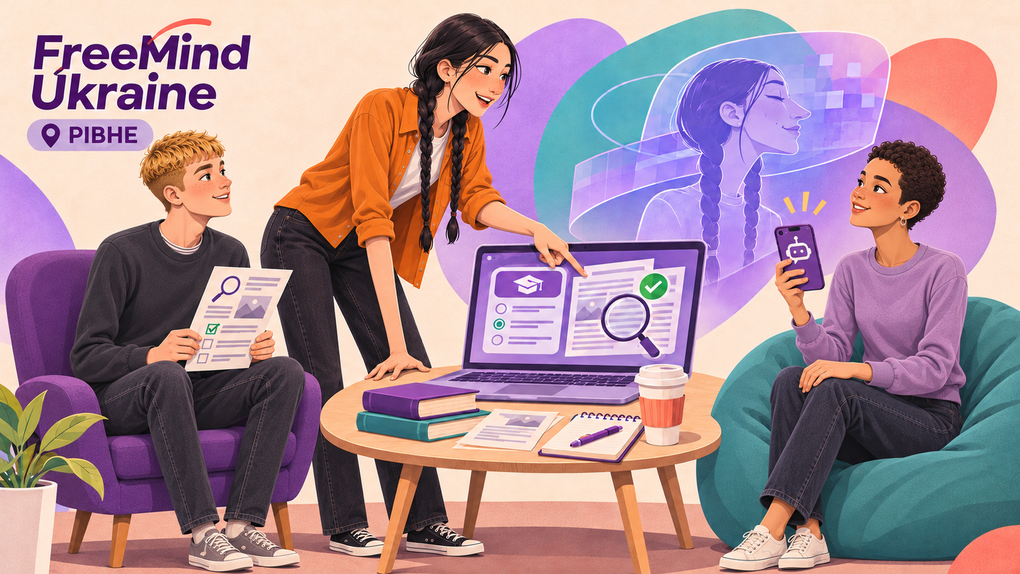
FreeMind Ukraine in Rivne: a digital alter ego and fact-checking for students
Students at the National University of Water and Environmental Engineering (NUWEE) presented two media literacy projects at the final round table in FreeMind Ukraine’s university series.
A confident chatbot answer may contain an invented link, while a familiar blogger may promote a dubious course. Rivne students used everyday situations like these as the basis for their media literacy sessions. After training with the Academy of Ukrainian Press (AUP), they prepared teaching resources themselves and invited their peers to verify information and examine their digital habits.
On 12 November 2026, the teams presented ‘Your Digital Alter Ego’ and ‘Media Literacy for the Digital Generation’ at an online FreeMind Ukraine round table. They explained how they had studied students’ information habits, selected examples and delivered training. It was the fifth and final meeting in the university series organised by AUP.
The work began at AUP’s two-day Rivne training on 13–14 October. Students analysed manipulation, checked AI answers and developed initiatives. A month later, they returned with experience of organising events for their own audiences.
From AUP training to independent work with audiences
AUP President Professor Valeriy Ivanov, Doctor of Philology, opened the meeting. He recalled that the initiatives formed part of cooperation between AUP and Freie Universität Berlin and thanked partners for joining the final stage.
‘What interested me in the Rivne projects was that students started with their audience’s specific habits: how they use AI, whom they trust on social media and what they check before reposting. Preparing a session requires understanding the subject yourself, finding convincing examples and explaining them to people who may ask unexpected questions. The Digital Alter Ego team invited participants to examine their behaviour; the second team prepared verification tasks and resources to use after the workshop. For AUP, this is a valuable result: our trainees organised sessions themselves and passed knowledge to other students. They also moved planned in-person events online and completed the work through to presenting results. I hope this experience will underpin further initiatives: they already have their own material and an understanding of their audience.’
Roman Hladkovskyi, Chief Specialist at the School Education Directorate of Ukraine’s Ministry of Education and Science, joined the discussion. In his welcome, he stressed media literacy’s importance for students’ future professional work. After the presentations, he praised the content and the teams’ explanations of their methods.
‘I welcome both projects, particularly how thoroughly students explained the sessions’ content and methods. They first explored their audience’s information habits, then chose topics and tasks accordingly. Digital Alter Ego’s everyday situations stand out: trusting bloggers, using AI and sharing alarming messages. Media Literacy for the Digital Generation has a carefully planned sequence: concepts, examples, verification tools and a final game. I would particularly mention the checklist and learning resources students can return to afterwards. I consider this work useful for further media education, while preparing and delivering it will benefit the authors professionally.’
AUP Project Coordinator Yuliia Kulyk moderated the discussion. Teams described how their plans had changed and what they had achieved.
‘We wanted to follow what happened to students’ ideas after training. Both Rivne teams planned in-person events but delivered them online because of security conditions. They reconsidered the format and still organised interaction. Students selected material, explained it, answered questions and found ways to involve participants in practice. This experience helps reveal how many decisions lie behind a learning session and what to consider next time.’
Professor Olha Mitchuk, Doctor of Social Communications and Head of NUWEE’s Department of Information Law and Legal Journalism, supported the teams. At the opening, she thanked AUP for cooperation and the opportunity to present student initiatives.
‘For our university and students who have already demonstrated their abilities in media literacy, it is a great honour to work alongside AUP and the Ministry of Education and Science. Thank you for the opportunity to belong to a community that cares about where we are, who we are and what we are like. Our meetings and cooperation bring results and help identify further work. Special thanks to Ms Yuliia for support and organisational guidance, and to Mr Valeriy for mentoring and helping us improve. I particularly value the students themselves: they want to work, know what they are striving for and care about what they do. We appreciate the trust and will try to meet the expectations of our joint work.’
‘Your Digital Alter Ego’: recognising your online habits
Alevtyna Volkova presented the first project. With Viktoriia Koval, Artem and Daryna, she prepared a survey and online training on social media behaviour and AI use.
The team first created a Google Forms survey to explore students’ use of social media and AI. Responses informed the session. Participants could also complete the questionnaire during training.
Alevtyna Volkova explained:
‘The survey primarily aimed to look at how people currently consume social media content and how actively they use artificial intelligence.’
Four patterns: AI, bloggers, alarming reposts and scrolling
The team invited participants to recognise themselves in four illustrative character types, each describing particular social media and AI habits.
‘Intellectual Parasitism’, as the team called one section, addressed excessive reliance on AI: copying chatbot answers, failing to check links or delegating work requiring independent analysis. The session discussed verifying generated material and responsibility for its subsequent use.
Viktoriia Koval explored the ‘digital manipulator’. She explained how bloggers may exploit followers’ trust, promises of quick success and artificial scarcity. A message about a course’s ‘last remaining places’, for instance, encourages payment before someone checks reviews, the author’s expertise and purchase terms.
The team also examined information panic. Participants were advised to pause before sharing messages provoking fear or anger, find the original source and seek confirmation. A hasty repost can spread anxiety and unverified information.
The fourth type, the ‘mindless scroller’, concerned endless feed-browsing. The authors suggested a simple stopping question: why did I open this app, and what do I want to find? It was intended to help people notice when deliberate searching turns into automatic video scrolling.
What the survey showed
The team said participants most often recognised the habits of an active AI user and a ‘mindless scroller’ in themselves. Their answers provided discussion material.
Air-raid alerts and distance learning required changes to the planned in-person event. The team moved the survey and meeting online and explained at the round table how it adapted audience interaction.
‘Media Literacy for the Digital Generation’: checking sources and explaining conclusions
Sofiia Voronova, Anton Sakhniuk, Arsenii Halyshko and Mariia Liashenko prepared the second project. Their online workshop examined questionable content and taught verification.
Preparation began with a 24-question Google Forms survey. In their final presentation, the team reported 21 responses. Questions covered news sources, checks before sharing and difficulties assessing content, including short videos.
The authors acknowledged the limits: a small set of responses helped prepare a session for a particular audience but did not justify generalisation to all students.
Four examples and verification tools
The workshop used a 23-slide presentation and four practical cases covering disinformation, misinformation, deepfakes and ‘jeansa’ – paid-for material disguised as editorial content. Participants discussed distinguishing inadvertent falsehoods from deliberate deception and recognising manipulation.
They then examined authorship, original sources, publication dates and supporting evidence. Image examples demonstrated Google Lens for finding earlier appearances of a photograph and checking context.
Links and QR codes let participants open the cases independently and return to them afterwards. The team used Ukrainian and international sources during preparation.
The workshop took place in Google Meet and concluded with a 14-question Kahoot game to revisit concepts and check understanding through play.
A checklist to keep after the workshop
Participants received the presentation in PowerPoint and PDF formats and a one-page ‘Check Before Sharing’ checklist. It reminds users to check the source, author, date, evidence and corroboration elsewhere before reposting.
The authors explained:
‘We also see an opportunity to continue this work, since the presentations, cases and checklists are already prepared.’
The team intends to reuse the resources. Asked about difficulties, members said combining theory and practice required the most attention: students needed tasks in which they would verify information themselves.
Earlier FreeMind Ukraine round tables
Before Rivne, teams from four other universities presented their work:
- 3 November, Cherkasy: from memes to a media quest.
- 4 November, Lutsk: a detective quest and a podcast about AI.
- 5 November, Poltava: an interactive AI game and university news on TikTok.
- 10 November, Zhytomyr: a Telegram meme game and a first-year media quest.
How the teams began
Read about the training where students developed their ideas:
- Poltava, 15–16 September: from analysing manipulation to student projects.
- Lutsk, 22–23 September: who edits our reality?
- Zhytomyr, 29–30 September: how manipulation works and what to do about it.
- Cherkasy, 6–7 October: from the ‘invisible editor’ to student initiatives.
- Rivne, 13–14 October: media literacy, AI and student initiatives.
News, resources and further information are collected on the FreeMind Ukraine platform.
The Academy of Ukrainian Press implements FreeMind Ukraine with Freie Universität Berlin, funded by the German Federal Foreign Office.
Translation note: This is a literary translation into British English, produced and proofread using a language model. Read the Ukrainian original.