FreeMind Ukraine: from understanding manipulation to exercises for your community
How can we teach media literacy so that people leave a session doing more than remembering the definitions of ‘false information’, ‘manipulation’ or ‘propaganda’, and actually change how they work with information? That was the question activists, schoolteachers, lecturers and community representatives explored at the FreeMind Ukraine trainers’ laboratory in August.
On 11–12 and 13–14 August 2026, the Academy of Ukrainian Press held two training events within FreeMind Ukraine: Youth and Communities Against Manipulation: online courses for trainers entitled Filter Information – Create Change: A Trainers’ Laboratory. A Hackathon of Practices. Participants worked on their own media literacy, but above all on how to teach these skills clearly and interactively, taking real information threats into account. A third summer session was scheduled for 17–18 August.
AUP implements FreeMind Ukraine in partnership with the Centre for Media and Information Literacy (CeMIL) at the Institute for Media and Communication Studies, Freie Universität Berlin, Germany. The project develops critical thinking and media literacy among young people and representatives of local communities in Ukraine.
Teaching people to act, not simply explaining media literacy
Participants in the August sessions received ready-to-use presentations and a handbook of practical exercises adaptable for different audiences. The laboratory’s purpose, however, went beyond introducing established methods.
Exercises were taken apart almost piece by piece: why a particular stage was needed, what reaction it should produce, which question a trainer should ask afterwards, and how to lead a discussion so participants could reach the necessary conclusions themselves.
The exercises were presented, played through, analysed and unpacked as teaching methods.
This is essential to preparing trainers. Even a good exercise does not guarantee results on its own. Trainers need to understand its logic: when to give participants freedom, when to ask a clarifying question, how to avoid turning a session into a lecture, and how to connect the experience with everyday information habits.
‘Telling an audience to “check information” or “not trust false stories” is no longer enough. People need a process they can follow and try for themselves. A good training exercise models a situation in which someone makes a decision, gets something wrong, analyses the mistake and understands what to look for next time. That is how knowledge becomes a skill,’ said Andrii Yurychko, media trainer, Candidate of Philological Sciences and lecturer at the Institute of Journalism, Taras Shevchenko National University of Kyiv.
A FreeMind Ukraine exercise available to everyone
To demonstrate this approach, we are sharing one of the exercise presentations used in the trainers’ laboratory.
Explore the slides below or use the numbered links to move to a particular slide.
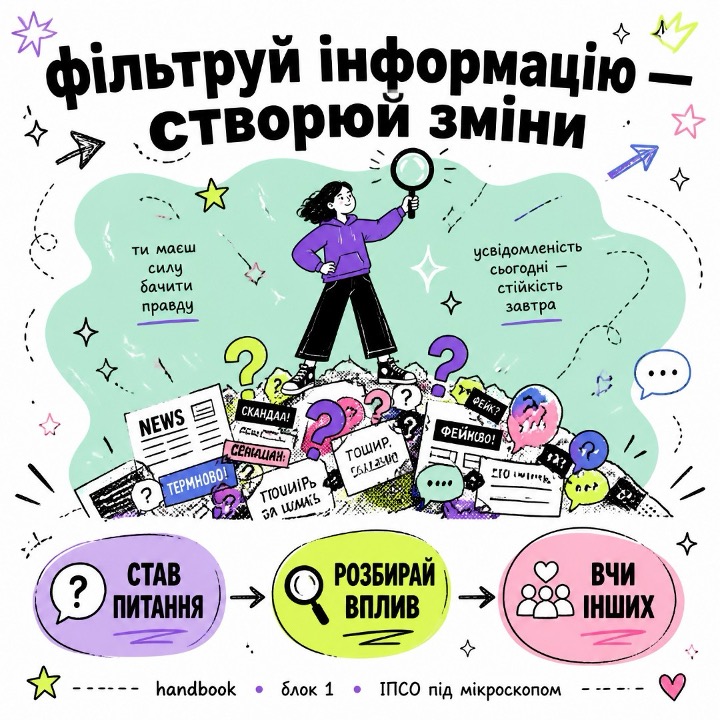
Slide 1. Filter Information – Create Change.
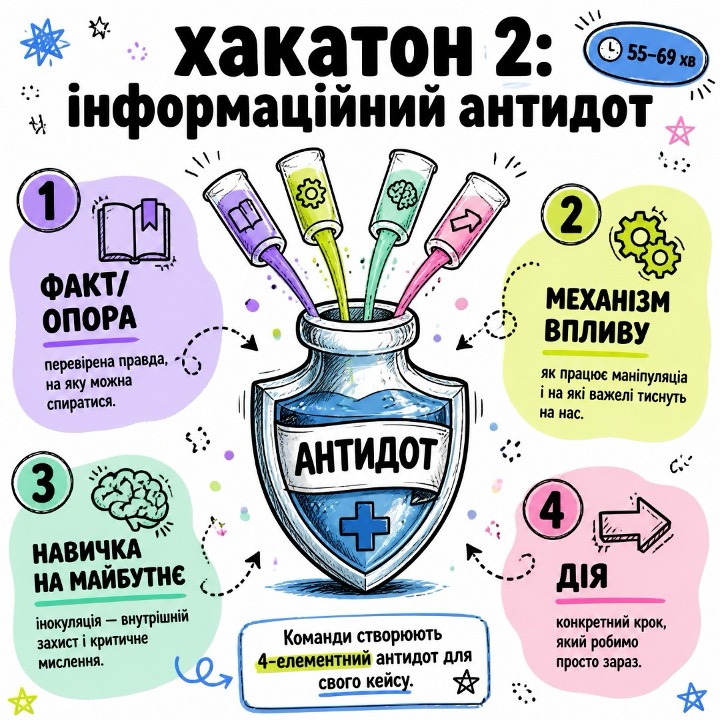
Slide 2. Information Antidote.
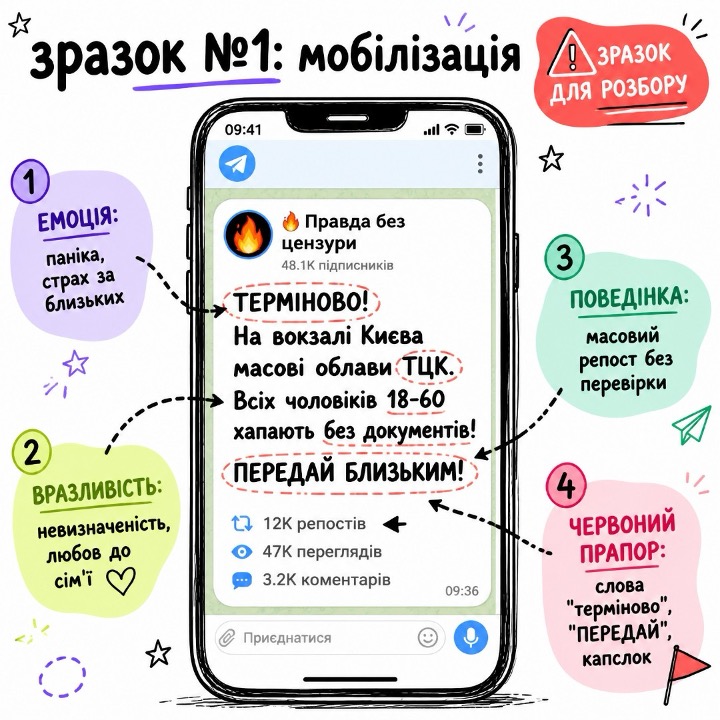
Slide 3. The ‘Mobilisation’ example.
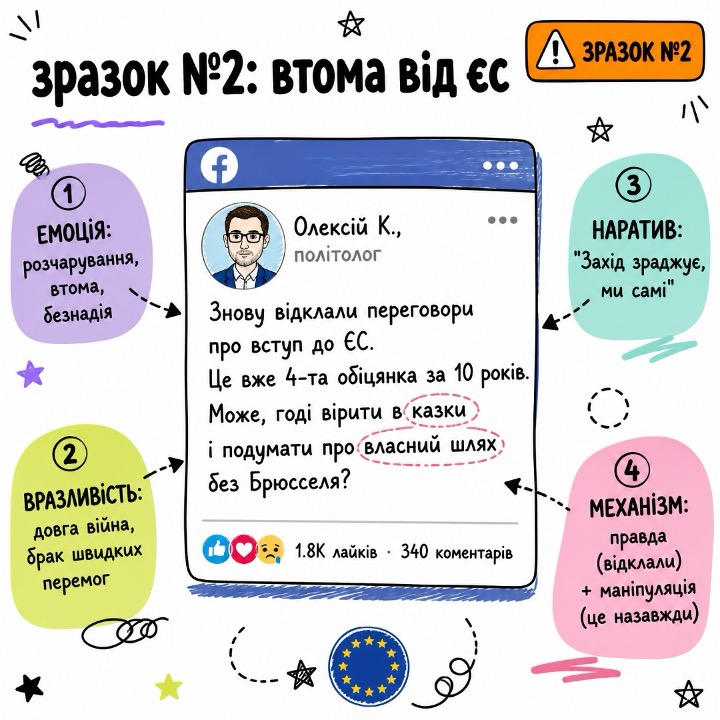
Slide 4. The ‘EU Fatigue’ example.
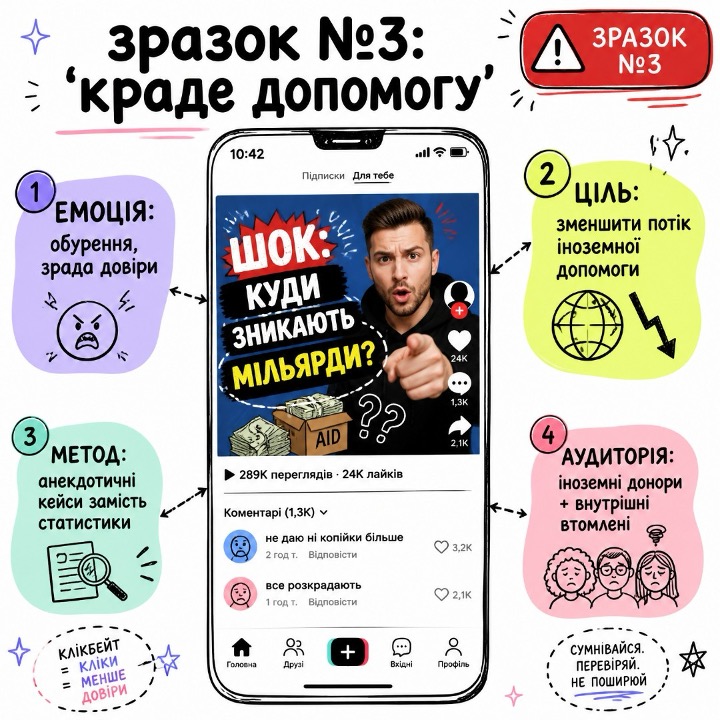
Slide 5. The ‘Stealing Aid’ example.
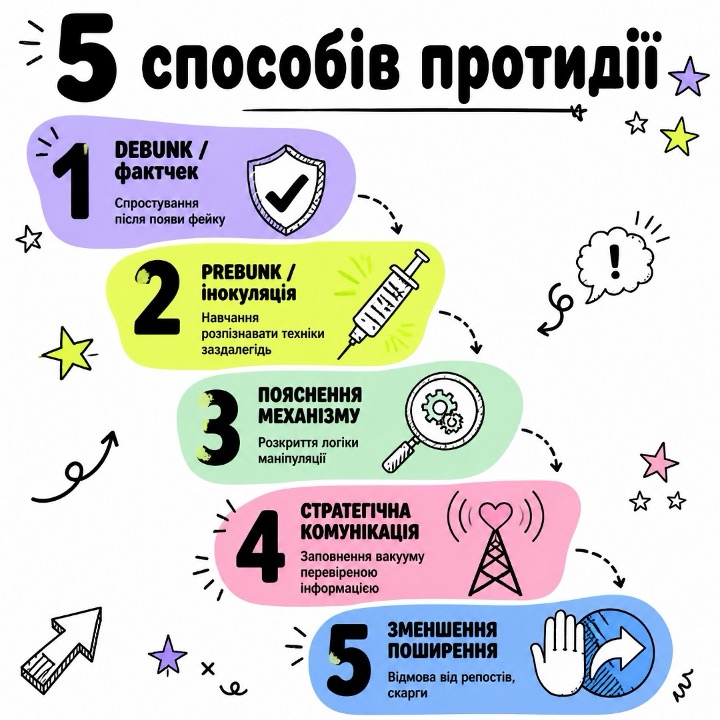
Slide 6. Five ways to respond.
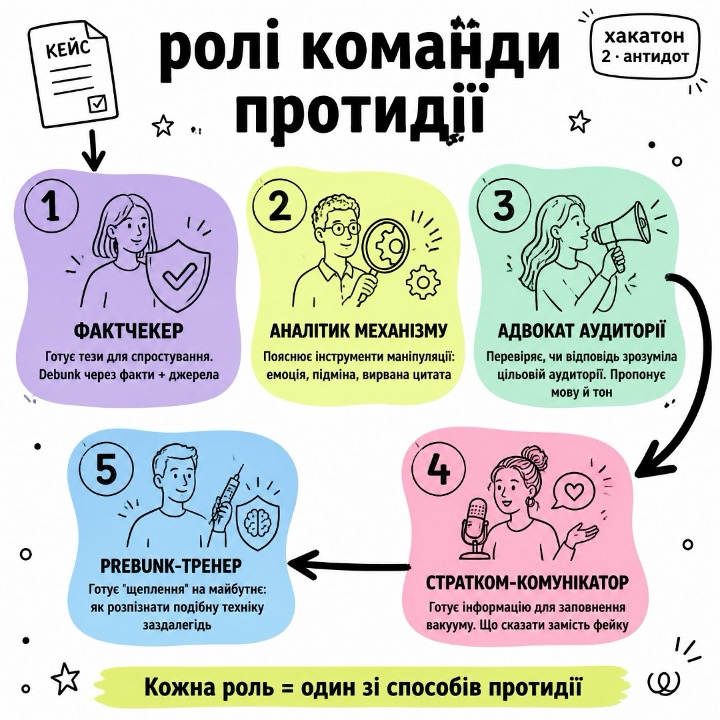
Slide 7. Roles in the response team.
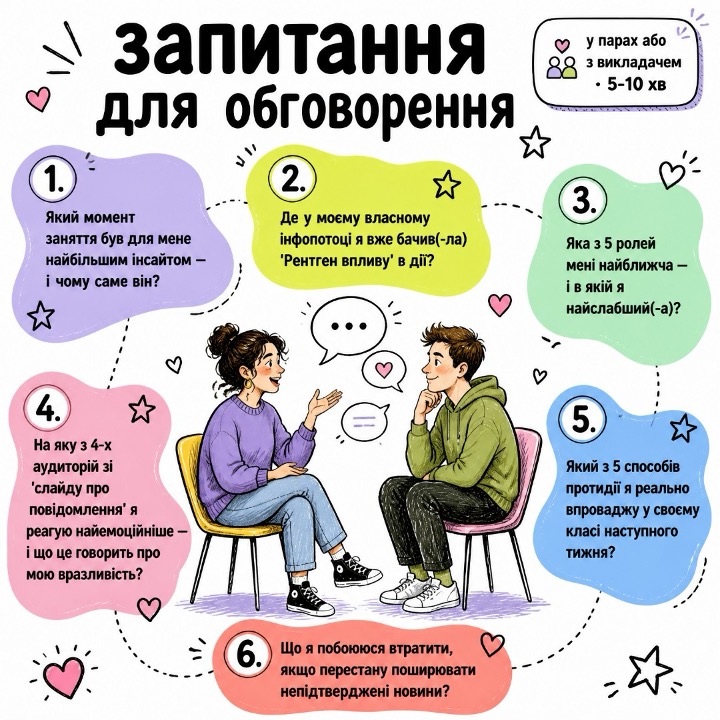
Slide 8. Questions for discussion.
This is an example of material for a short media literacy and critical thinking session with school pupils, university students, adults or participants in community education events.
FreeMind Ukraine resources are not intended to remain within a single training course. The project’s idea is to multiply knowledge: participants receive tools, adapt them to their audiences and deliver sessions in schools, universities, civil society organisations and local communities.
This principle is built into the laboratory’s model. Participants must both complete their training and pass the knowledge on.
A hackathon of practices: participants become authors
The hackathon of practices is another part of the programme.
After exploring the methods, participants developed and presented their own approaches to media literacy and critical thinking sessions.
This changes their role. Instead of simply listening to an expert’s ready-made scenario, participants become teaching-method designers: defining the problem, audience and learning objective, choosing how people will interact, and considering what result the exercise should achieve.
Presentations therefore addressed both ‘What have we devised?’ and ‘Why should it work?’
‘A teaching method begins with the person for whom we are designing a session. Teenagers and adults perceive information differently; their experiences, information habits and triggers of trust differ. Even an excellent exercise cannot simply be taken and delivered identically to everyone. Today’s trainer needs to understand the audience, speak its language and provide tools that help people do more than recognise a particular false story: they need to develop a habit of assessing information critically,’ said Tetiana Ivanova, media expert, Doctor of Pedagogical Sciences, Professor and Head of the Department of Social Communications at Mariupol State University.
This approach matters particularly during the full-scale war, when the information space is part of the confrontation. Manipulative content can appeal to beliefs, but also to fear, exhaustion, outrage, a sense of injustice or the desire to help immediately.
Critical thinking does not mean ‘believe nothing’. It means pausing before reacting, asking questions, assessing the source, recognising the emotional mechanism, finding corroboration and only then deciding whether to believe, share or act.
From one trainer to dozens of people
FreeMind Ukraine is designed for learning to continue after its events.
The programme includes online training for opinion leaders and community representatives, mentoring for media literacy initiatives and support for multiplier events in communities. It also provides separate learning formats for young people and develops the FreeMind Community network.
The intended result is therefore more practical than a group who know more about disinformation: it is a wider circle of people able to teach others to work with information consciously.
An exercise refined during the hackathon could later be used in a school lesson, university class, civil society meeting or training for community residents.
FreeMind Ukraine continues
The August meetings are not the end of the training. Further laboratory groups will work between 2 and 8 September 2026.
Participants will continue testing practical formats, analysing exercises, developing their own teaching approaches and preparing to pass their knowledge to their audiences.
Resilience to information manipulation does not emerge from a single lecture. It develops through repeatedly practising critical thinking’s central question:
‘How do I know this, and why am I prepared to believe it?’
If you understand how fragile trust in the information space is during wartime, and want to learn to protect it for yourself and your community, join FreeMind Ukraine.
Complete the registration form.
Trainers and experts
- Tetiana Ivanova, media expert, Doctor of Pedagogical Sciences, Professor and Head of the Department of Social Communications at Mariupol State University.
- Andrii Yurychko, media trainer, Candidate of Philological Sciences and lecturer at the Institute of Journalism, Taras Shevchenko National University of Kyiv.
AUP’s implementation partner is the Centre for Media and Information Literacy (CeMIL) at the Institute for Media and Communication Studies, Freie Universität Berlin, Germany.
CeMIL is part of the university’s Institute for Media and Communication Studies and brings up-to-date media literacy expertise. It has extensive experience of training and research with journalists and communication scholars from Eastern European countries and has successfully managed projects in previous rounds of Eastern Partnership programmes.
Translation note: This is a literary translation into British English, produced and proofread using a language model. Read the Ukrainian original.