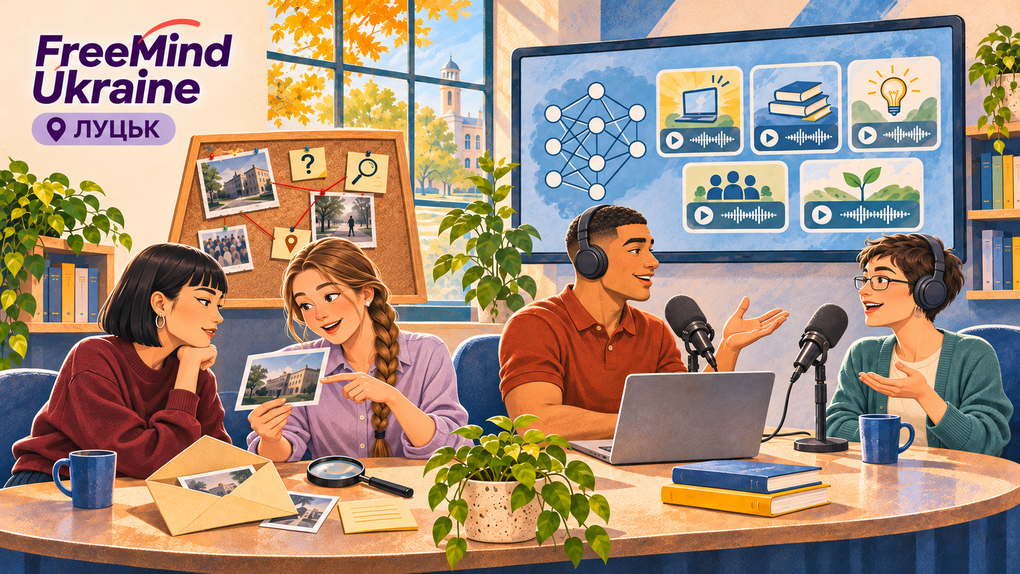
FreeMind Ukraine in Lutsk: a detective quest and a podcast about artificial intelligence
Illustration created using AI.
Lutsk National Technical University students present their own media literacy projects
First-year students investigated a fictional story, collected evidence and checked photographs. Another student team produced a five-part podcast about artificial intelligence. Both teams presented their results at an online FreeMind Ukraine round table on 4 November 2026.
The students showed their materials, described how they had prepared them and explained what interested their audiences. Together with the Academy of Ukrainian Press team, a representative of Ukraine’s Ministry of Education and Science and a university lecturer, they discussed how the work could be used in teaching.
The Academy of Ukrainian Press and Freie Universität Berlin run ‘FreeMind Ukraine: Youth and Communities Against Manipulation’. AUP trains and advises participants as they develop their own initiatives. In Lutsk, this work began with the ‘Invisible Editor: Who Shapes Your Information Reality?’ training on 22–23 September 2026. Students examined information manipulation and developed ideas they could implement at their university.
‘Practical skills are learnt more effectively when students complete tasks themselves and see where their decisions lead. In a quest, they check evidence and learn not to trust first impressions. Gamification lets them practise these skills in situations familiar to young people. Video is among the most popular news formats for young audiences, so a YouTube podcast is an appropriate way to explain how to work with AI,’ said Professor Valeriy Ivanov, President of AUP and Doctor of Philology.
AUP Media Education Programme Manager Maksym Zaporozhchenko moderated the round table. Discussing the projects, he explained why learners need opportunities to find answers for themselves:
‘Our work follows a model of developing different competences, including critical thinking as a cross-cutting skill. It should not be a blunt instruction: this is fake and that is not. The skill should develop naturally through practice, through formats in which people reach their own conclusions. It is then more likely to stay with them throughout their lives,’ Maksym Zaporozhchenko said.
‘The work is quite substantial. I liked the quest and particularly the artificial intelligence project. AI is already part of our lives, and we need to understand how to live with it. The question is no longer whether to use it. Above all, we must be able to distinguish where it is actually present and where it is not,’ said Roman Hladkovskyi, Chief Specialist at the School Education Directorate of Ukraine’s Ministry of Education and Science.
‘Who was with him that evening?’: a detective story for first-year students
Second-year journalism students Kateryna Povazhuk and Vitalina Chaika devised a quest in which first-year students checked evidence and distinguished facts from assumptions. Participants had to unravel a fictional story involving Maks, Sofiia and Dasha.
It began during a class. The first-year students did not yet know an investigation awaited them when a prepared photograph appeared on the screen. They then received an envelope containing their first clue and began collecting evidence.
The authors chose a story close to students’ experience to show how easily people can believe unverified information and jump to conclusions.
‘The idea grew out of wanting to find an engaging way for students to learn and develop critical thinking. We did not want a conventional event where participants simply listened to information. It mattered to us that they solved tasks themselves, analysed different situations and looked for answers,’ Kateryna Povazhuk said.
Each station focused on a particular journalism skill. Students distinguished facts, judgements and assumptions, worked with open and closed questions, and identified main and secondary information.
At the ‘Journalists in Three Minutes’ station, they had to find three people, record short video comments on a set topic and devise a headline. The task required them to approach interviewees and gather the necessary information quickly.
In the final stage, participants received photographic evidence, including genuine photographs and AI-generated images. They examined the material closely and tried to distinguish real photographs from generated ones. The organisers then discussed checking sources and finding corroboration.
‘With this task, we wanted to show how easy it is today to create a false image and use it to mislead people. After the investigation, we held a discussion emphasising the importance of checking sources, finding corroboration and critically assessing any information. For a journalist, it is important not simply to see evidence but to establish that it is authentic,’ Vitalina Chaika explained.
At the end, the first-year students wrote letters to their future selves, sharing thoughts about the profession and describing how they imagined themselves in a year’s time. Kateryna and Vitalina plan to keep the letters and return them to their authors next year.
The organisers observed that participants became absorbed in the story, discussed clues and tried to establish what had happened. At the round table, the team showed a video of the quest.
‘The Art of Managing Artificial Intelligence’: a five-part podcast
Mykhailo Lypovchenko presented the second project. He and his team produced an AI podcast comprising five episodes, each lasting four to five minutes.
The authors wanted to explain how to use AI, understand its limitations and verify generated content. They chose five topics:
- The history of AI: how the ideas and technologies preceding today’s tools developed.
- AI ethics: personal data, copyrighted material, deepfakes and disclosure of AI use.
- Disinformation: fabricated answers and sources, and the use of generative tools to mislead audiences.
- Content verification: tools and a sequence of steps for analysing suspicious material.
- Writing prompts: how to set tasks for AI and use it to support one’s own work.
During his presentation, Mykhailo showed podcast excerpts and explained the production process. The team used AI to look for possible sources, prepare script drafts and create some images. Students selected the material, decided the structure of the episodes and edited the scripts.
Editing took considerable time. According to Mykhailo, producing a five-minute episode could take three or four days. Images and examples accompanied the explanations.
The episodes are collected in a YouTube playlist. The team is also considering YouTube Shorts to attract new viewers. Mykhailo explained how they intend to use the material:
‘Our overall idea is that this should not be a one-off project. People can discover the videos at any time: in ten days or ten weeks. We see them as a small educational resource that can be used for other projects and interactive tasks,’ he said.
What the discussion covered
The organisers asked students about preparing material, involving participants and the time required. Kateryna and Vitalina described finding a storyline and people to play the characters. Mykhailo explained the team’s work on podcast scripts and visuals.
Professor Liudmyla Mialkovska, Doctor of Philology and Head of LNTU’s Department of Media, Image and Communication, shared her observations. She had taken part in the quest: first-year students came to her for a task at one station. She described how they gradually became engrossed in the investigation and discussed the evidence.
In her view, the quest can serve as a practical critical-thinking task. She suggested using the podcast in university classes:
‘His work is already a finished media product. It can be used in teaching. For example, we have a course called “Mass Communication and Information”. We can use it for students to watch and learn from,’ Liudmyla Mialkovska explained.
At the end of the meeting, students thanked AUP for the training, trust and mentoring that had helped them put their ideas into practice.
The Academy of Ukrainian Press implements FreeMind Ukraine with Freie Universität Berlin, funded by the German Federal Foreign Office.
Read about the training preceding these initiatives in Cherkasy, Lutsk and Poltava, and about five student media literacy projects in Cherkasy.
The article on student project presentations in Poltava will be available on 6 November at 10:00.
The FreeMind Ukraine platform brings together project news, learning resources and additional information for participants and anyone interested in media literacy.
Translation note: This is a literary translation into British English, produced and proofread using a language model. Read the Ukrainian original.